Electric Bikes in Paris: What Really Changes
A few years ago, a cycling-enthusiast friend confided in me, with a hint of shame: “I’ve given in. I bought an e-bike.” He was bracing himself for a lecture. I told him it might be the smartest decision he’d ever made on two wheels. Since then, he’s convinced his wife, his neighbours, and I believe even his 72-year-old father-in-law. That’s the introduction.
The electrically-assisted bicycle (e-bike) is not a gadget for the lazy. It’s a tool — like a good lever, it multiplies effort without replacing it. But it’s worth understanding what the assistance actually changes, and what it doesn’t.
What does electric assistance actually do in the city?
Contrary to what some purists fear, the e-bike doesn’t turn the cyclist into a passenger. Electric assistance only kicks in when you’re pedalling — and cuts out at 25 km/h for models approved in France. It’s not a disguised moped.
What assistance concretely changes in Paris:
- The hills (yes, even in Paris they exist — Montmartre, Belleville, Ménilmontant). On a cargo bike loaded with two children and shopping, the difference is spectacular.
- Starting at traffic lights. In Parisian traffic, pulling away effortlessly after each stop significantly reduces fatigue.
- Perspiration. It sounds trivial, but it’s decisive for professionals who need to arrive at the office in smart clothes.
- Psychological distance. Trips you previously avoided (20 km return journeys, for example) become entirely feasible.
What assistance doesn’t change: your need to pay attention, to signal your changes of direction, to respect right of way. And on flat roads with low assistance, you pedal almost exactly as you would on a conventional bike.
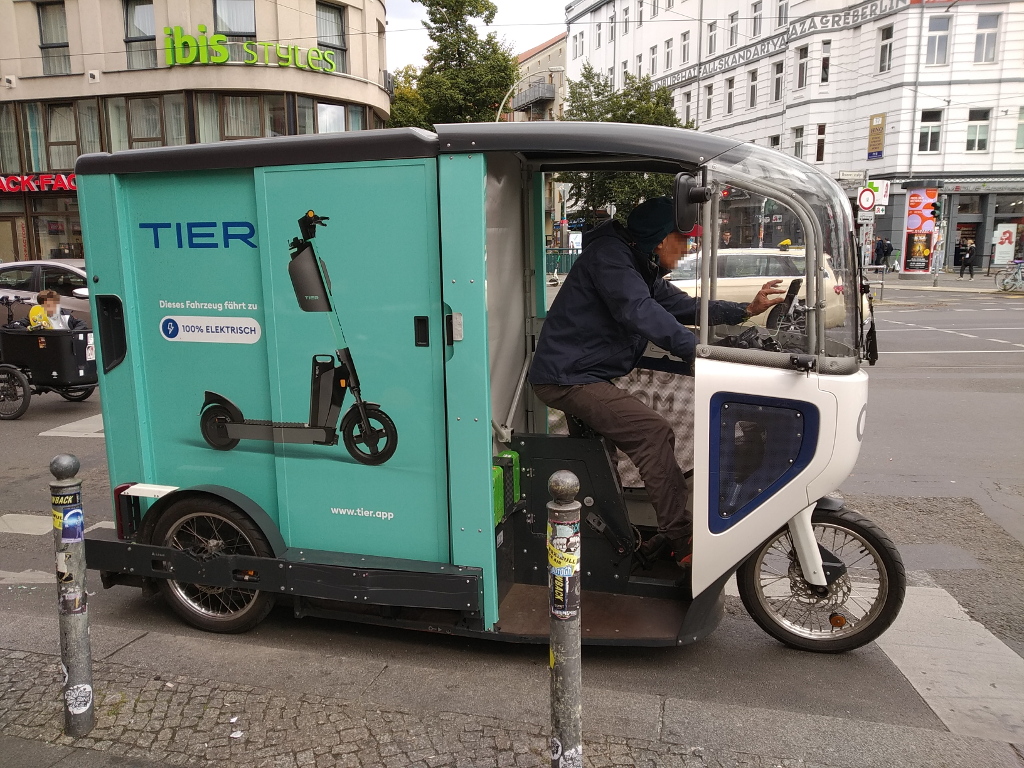
Real-world range with a loaded cargo bike
Manufacturers advertise optimistic range figures. The reality is more nuanced.
An electric cargo bike such as the Riese & Müller Load 75 or the Tern GSD S10 typically claims 80 to 120 km of range. With two children on board, full panniers, and assistance set to level 3 (out of 5), expect closer to 40 to 60 km in real Parisian conditions — frequent stops, repeated acceleration, winter cold that penalises the battery.
For daily use in Paris (a home-school-office journey of 15 to 25 km return), this is more than adequate with a charge every two to three nights.
Bosch Performance Line CX (750 Wh) or Shimano EP8 batteries currently offer a good weight-to-range compromise. Bikes fitted with dual batteries (such as certain Riese & Müller models) can reach 150 km, but at the cost of significant extra weight and a considerably higher budget.
Charging: time, cost, solutions without a cellar
Charging is often the first concern raised by Parisians living in flats. Here are the realities:
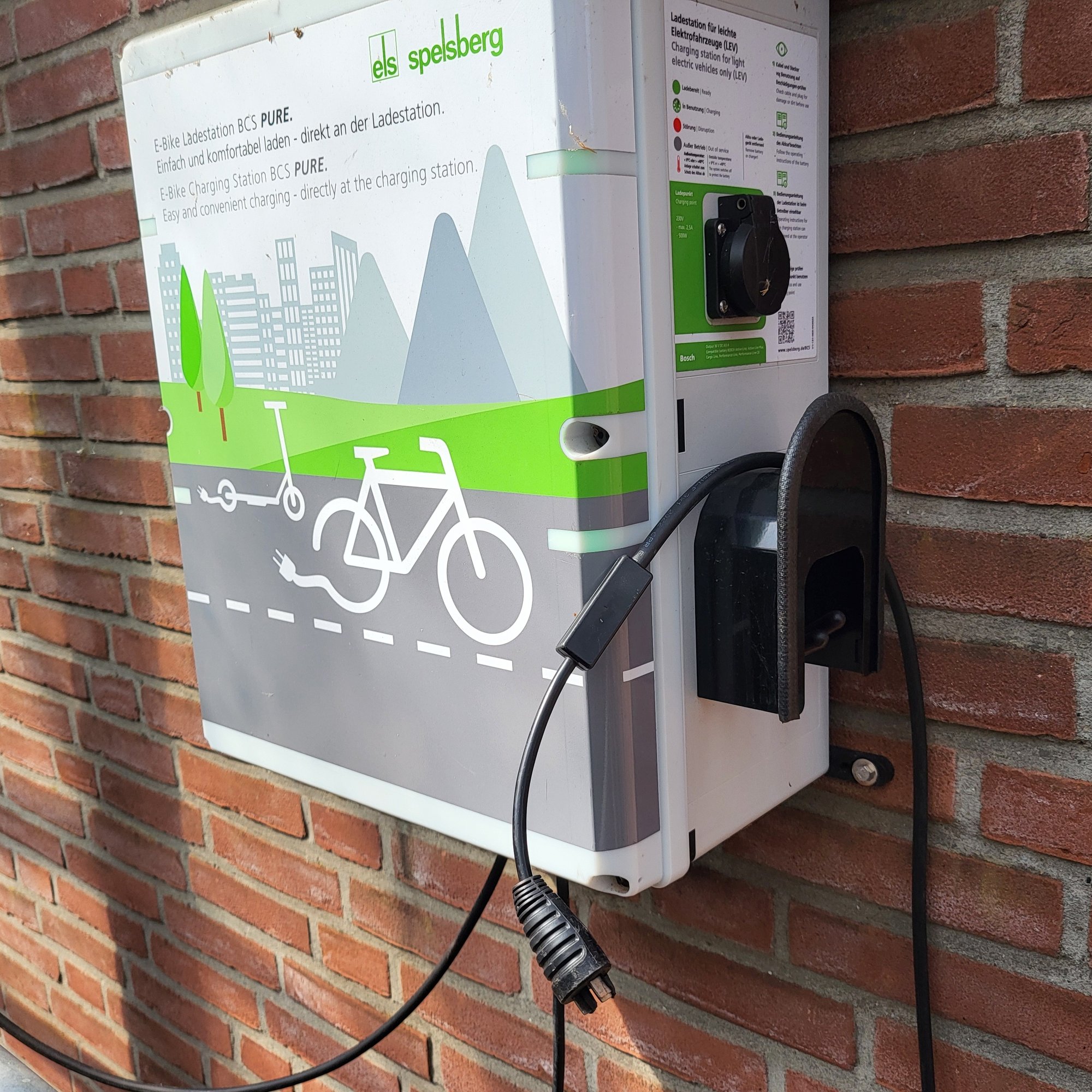
Charging time: a 500 Wh battery charges in 4 to 5 hours with the standard charger. Fast chargers (available as an option from Bosch or Shimano) bring this down to 2h30–3h. Plug in in the evening, pick up in the morning: the routine establishes itself naturally.
Energy cost: a full charge consumes around 0.6 to 0.8 kWh, which amounts to less than 15 centimes at current EDF rates (approximately €0.20/kWh in 2024). Over a year of daily use, expect €40 to €60 in electricity. Compare this with a Navigo monthly pass (€900/year) or the costs of running a moped.
Without a cellar or garage: most modern batteries detach from the bike in 10 seconds. You carry the battery alone up to the flat (it weighs 2.5 to 3.5 kg depending on the model), charge it from a standard socket, then bring it back down. A solution adopted by thousands of Parisians.
Some residential buildings are now installing sockets in their bicycle storage areas — a trend encouraged by the LOM Act (Loi d’Orientation des Mobilités) of 2019, France’s national mobility framework legislation.
Battery maintenance and longevity
The battery is the centrepiece — and the most costly part to replace (€400 to €900 depending on the model). A few simple rules to preserve its lifespan:
- Don’t store it fully charged at 100% or fully depleted at 0%. The ideal: between 30% and 80% for long-term storage.
- Avoid extreme temperatures: don’t leave the bike (or battery) in intense cold (below -5°C) or in direct sunlight in summer.
- Charge regularly, even if you’re not using the bike — a lithium-ion battery left flat deteriorates more quickly.
Reputable manufacturers (Bosch, Shimano, Brose, Fazua) guarantee their batteries for a minimum of 500 charge cycles, which equates to 3 to 5 years of daily use before capacity drops below 80%. After that, the battery still works — just with reduced range.
The bikes that won us over — and those that disappointed us
Without claiming to be exhaustive (the market moves quickly), here is our honest feedback:
What won us over
Tern GSD S10: compact, powerful, versatile. It fits in a lift, carries 200 kg, and takes two children and shopping. The Bosch Cargo Line motor is quiet and progressive. Price: around €4,500.
Riese & Müller Packster 70: the premium front cargo bike. Impeccable German build quality, dual battery available, remarkable ride comfort. Price: from €6,000.
Gazelle Ultimate C380+ HMB: for solo commuters seeking comfort and style. The Enviolo hub (continuously variable transmission) is a revelation.
What disappointed us
Entry-level models under €1,500 from certain no-name brands promise a great deal on paper. In practice: noisy motors, batteries that lose 30% of capacity during the first winter, non-existent after-sales service. The budget e-bike is often a false economy.
Low-end torque sensors (which measure speed rather than effort) produce jerky, unnatural assistance. A good torque sensor (Bosch, Shimano EP8) transforms the experience entirely.
Total budget over 3 years: e-bike vs conventional bike
A fair comparison:
| Item | Quality conventional bike | Mid-range e-bike |
|---|---|---|
| Purchase | €800 | €2,800 |
| Annual maintenance | €150 × 3 = €450 | €200 × 3 = €600 |
| Energy | €0 | €50 × 3 = €150 |
| 3-year total | €1,250 | €3,550 |
The gap is real. But it narrows if you compare the e-bike with public transport (€2,700 in Navigo passes over 3 years) or a car (total cost well above €10,000 over 3 years for a Parisian).
Furthermore, several subsidies exist to reduce the entry cost: - National e-bike bonus: up to €400 (means-tested) - Conversion bonus: up to €1,500 if you scrap an old petrol vehicle - Regional and local subsidies: the City of Paris and the Île-de-France region offer additional support — check Paris en Selle
With these subsidies combined, the extra cost of an e-bike can fall to under €1,000 compared with a good conventional bike.
Conclusion: a tool, not a promise
The e-bike doesn’t solve every problem for the Parisian cyclist. It doesn’t replace a good lock, training in dense traffic, or the habit of reading priority road markings. It doesn’t make black ice in January or the cobblestones of the Marais disappear.
But for families on the fence, for commuters put off by perspiration or hills, for parents who would like to give up the car but find the school run too demanding — the e-bike really does change things. Not by magic, but through intelligent amplification of human effort.
As my converted friend said, after six months on an electric cargo bike: “I don’t understand why I waited so long.”
Neither do I, when it comes to it.
— Henri D.