Paris from the Saddle: What Cycling Taught Us About Our City
There are things you cannot see from the Métro. Nor from a car. Things that only reveal themselves when you pedal, hands on the handlebars, wind in your face, at the exact height of the human gaze. Five cyclists, five stories, five different Parises — and yet, when we compare our road notes, the same observations keep coming back, the same surprises, the same silences.
Here is what Paris has taught us — those of us who traverse it by bike.
Social geography is written into the tarmac
Before I started cycling regularly in Paris, I had no idea how unequal the city’s surface really is. Running or walking, you feel the slopes. In a car, power steering erases everything. But on a bike, your body becomes a genuine social barometer.
The Haussmannian neighbourhoods of the 8th and 16th arrondissements offer wide avenues, well-maintained cycle lanes, and smooth tarmac. You ride fast, you feel safe. Then you cross into the 13th, the 19th, or the 20th: the lanes narrow, the potholes multiply, conflicts with cars increase. This is not merely an impression — a study by Apur (the Atelier parisien d’urbanisme) published in 2022 confirms it: the quality of cycling infrastructure varies significantly between arrondissements.
Cycling also reveals invisible borders. The Périphérique — the ring road you fly over without a second thought by car or Métro — becomes a mental and physical obstacle on a bike. Crossing at Porte de Pantin or Porte d’Ivry, you feel that you are leaving something behind, and entering a territory where the rules of the road change, where the looks you receive change.
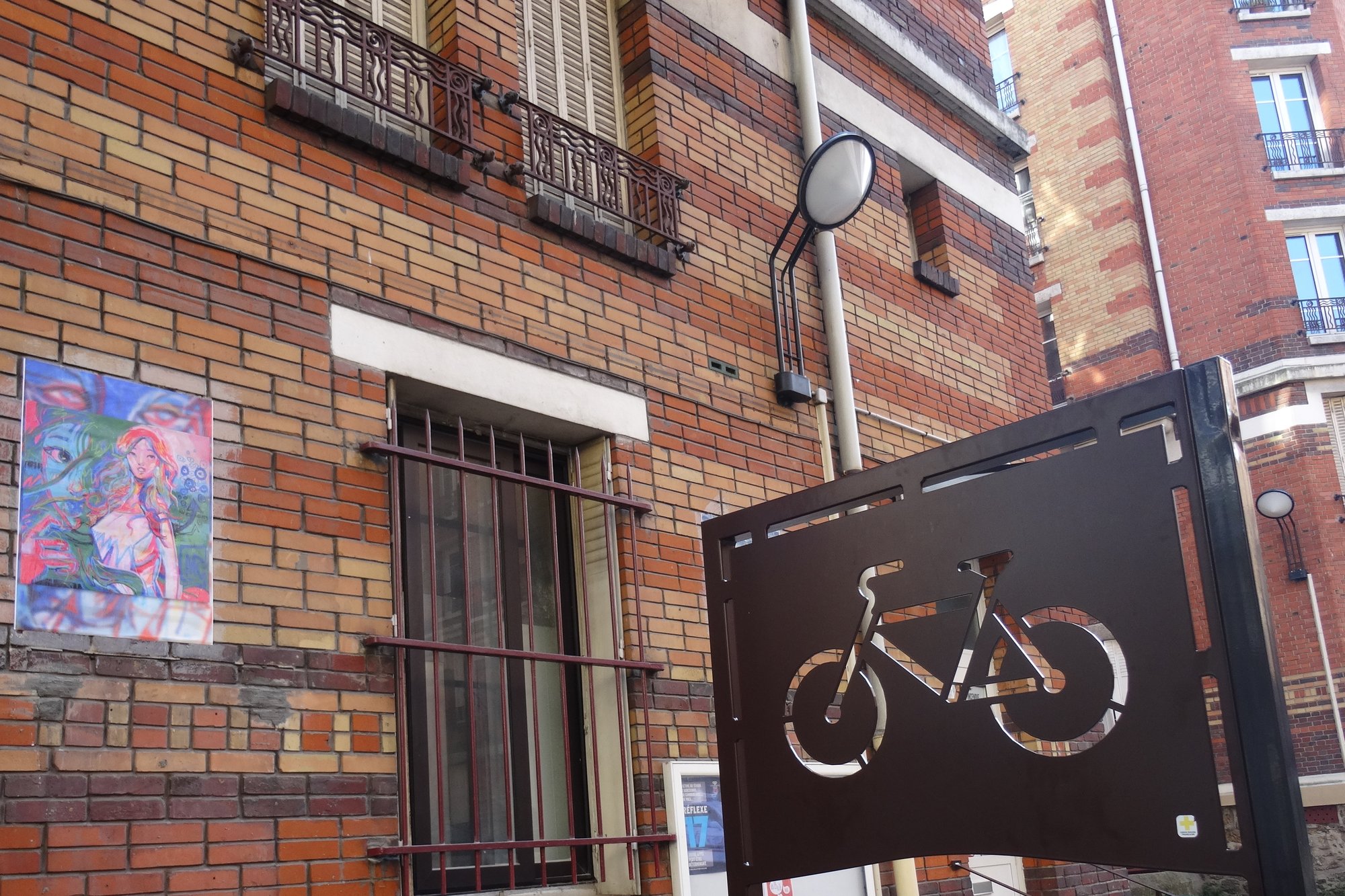
The areas we avoid — and why
To be honest, it must be said: there are stretches we go out of our way to avoid. Not out of snobbery, but out of a survival instinct.
Beginner level: The main boulevards during rush hour (Sébastopol, Voltaire, Nation) are to be avoided absolutely on weekdays between 7:30 and 9:30, and between 17:00 and 19:30. The density of delivery scooters, overflowing buses, and opening car doors — it’s an exhausting combination even for experienced cyclists.
Intermediate level: The La Défense business district and its surroundings (Neuilly-sur-Seine along the Avenue Charles-de-Gaulle) concentrates a level of automotive aggression found nowhere else in Paris. Drivers are in a hurry, bus routes are numerous, and cycle infrastructure is virtually non-existent on some stretches. Avoid if you don’t have solid urban cycling experience.
Advanced level: The major arteries of the 15th (Boulevard Victor, Boulevard de Grenelle) and the 12th (Avenue Daumesnil before the Viaduc des Arts) are manageable, but demand constant attention. On the other hand, once you reach the quays along the left bank of the Seine, you discover a serenity you never suspected was there.
The aggression you encounter at the handlebars — the kind directed at you, not the kind you generate — depends less on the arrondissement than on the type of road. A shopping street in the 11th at 11 in the morning is infinitely more pleasant than a boulevard in the 7th at 8:30.
What we never noticed before
This is perhaps the most precious revelation: cycling offers a city at eye level, at just the right speed.
From the Métro, Paris amounts to underground corridors and station exits. From a car, the façades flash by too quickly. On a bike, you have time to look up. You discover sculpted cornices on the fourth floor of ordinary buildings. You notice commemorative plaques hidden in dead ends. You stop in front of half-open courtyards that reveal secret gardens.
You also discover Paris’s working-class memory. The Art Deco shop signs of former wholesale merchants in the Sentier district. The traces of former railway lines in the 13th arrondissement, converted into planted walkways. The covered passages of the 2nd arrondissement, which you can stroll through pushing your bike, and which feel as though they belong to another era entirely.
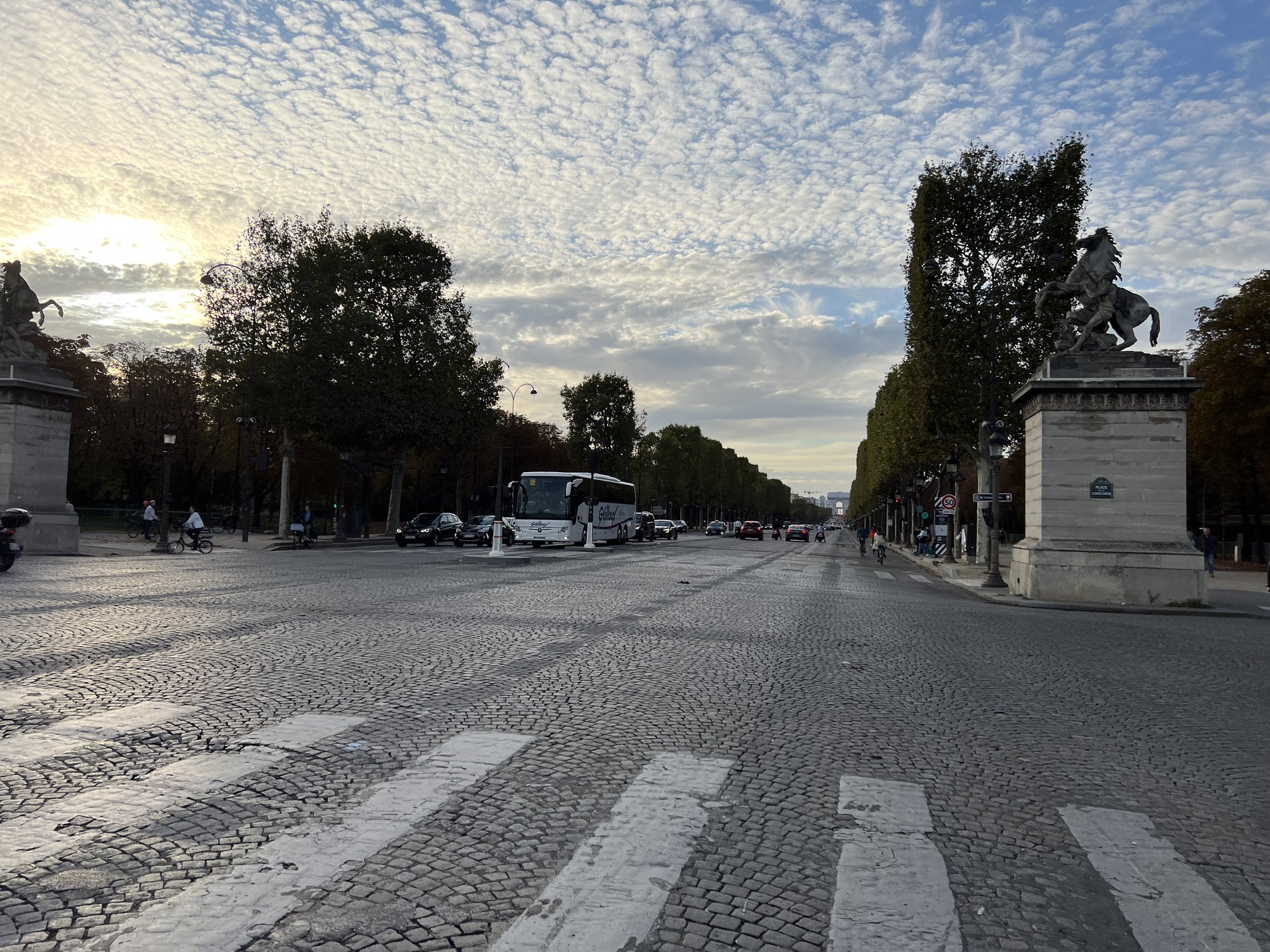
On a bike, you also perceive the smells of Paris — something always overlooked in urban analysis. Fresh bread outside a boulangerie at 7 in the morning. Coffee from café terraces at 9. Open-air markets where the aromas of coriander and strawberries mingle. The bicycle makes the city olfactory.
The city at night: another Paris
Paris at night by bike is an experience all of its own. For those who dare — and it must be said, it takes a certain acclimatisation — the reward is immense.
The riverside roads, closed to motor traffic since 2016, become silent motorways. You follow the Seine beneath the lights of the bridges, almost alone, between 11 pm and 1 am. The Quais de Javel, the Pont de Bir-Hakeim lit up like a film set, the Trocadéro seen from below — all of this belongs to the nocturnal cyclist.
The night also reveals inequalities in safety. Some well-lit routes (Rue de Rivoli, the Grands Boulevards) remain perfectly rideable. Others, less frequented and less well lit, become anxiety-inducing. Practical tip: invest in a powerful front light (minimum 200 lumens) and wear a reflective vest. It’s not just a legal matter — it’s a matter of survival.
Delivery cyclists — the riders of the delivery platforms — traverse Paris at night in every direction. You often cross their path, and sometimes exchange a glance of solidarity. They know the city better than anyone: its shortcuts, its pitfalls, its windows of clear traffic.
The seasons by bike: Paris changes its face
Paris in winter is not Paris in summer — cyclists know this better than anyone.
Spring (March–May): This is the blessed season. The days lengthen, the light is beautiful, and the parks begin to turn green again. The Bois de Vincennes in the morning, with the cherry trees in bloom and the first swallows — it’s a moment that only a bicycle allows you to experience fully.
Summer (June–August): Paris empties out, and for the cyclist, this is liberation. The streets of the centre, usually clogged, become almost pleasant. Paris Plages transforms the riverbanks into a playground. The downside: the heat. Set off before 9, return after 8 in the evening. The midday heat of July in the city is punishing.
Autumn (September–November): The low-angled light of the Parisian autumn is the finest. Fallen plane-tree leaves litter the cycle lanes — watch your braking, especially in the rain. This is also the season when tyres begin to skid on the painted markings at junctions. For beginners: reduce your speed by 20 to 30% as soon as the road surface is wet.
Winter (December–February): The great ordeal. A few days of frost turn Paris into an ice rink. You need to let a little air out of your tyres, ride even more cautiously, and anticipate braking from much further back. But there is a reward: Paris in the winter mist, streetlamps reflected in puddles, the unusual silence of the streets — it’s an austere beauty that very few Parisians ever know.
Our five perspectives, our five Parises
We compared notes after months of cycling together and apart. Here is what emerged:
Antoine, 34, engineer in the 9th: Cycling taught me that Paris is a city of flows. From the office, I only ever saw destinations. On a bike, I see movements, rhythms, pulses. The city breathes.
Mariam, 28, law student in the 13th: I rediscovered my own neighbourhood. Streets I used every day on the Métro, whose names I didn’t even know. On a bike, I developed a spatial memory of Paris that I simply didn’t have before.
Thierry, 45, head chef in the 11th: What struck me was the solidarity between cyclists. A glance, a nod, and sometimes a hand to fix a puncture. There’s an invisible community here.
Léa, 22, graphic designer in the 18th: At night, Paris belongs to cyclists. I cycle home from work at 1 in the morning, and those are my favourite journeys. The city is mine.
And me, Sophie, from Strasbourg: What strikes me every time I visit Paris by bike is the density. Strasbourg is naturally cyclable — the topography, the scale, the culture. Paris is a conquest. Every journey is a small challenge. And that’s precisely what makes it exhilarating.
What cycling really taught us
Paris from the saddle is not a metaphor. It’s a method. A way of inhabiting the city rather than simply passing through it. The bicycle imposes a chosen slowness — fast enough to cover real distances, slow enough to see, to smell, to understand.
The city rewards the curious. It punishes the hurried. And cycling, strangely, makes us patient — while giving us the freedom to go wherever we please, with no imposed timetables, no missed connections, no doors slammed in our faces.
Five people, five trajectories, five visions. But one consensus: once you have seen Paris from a bicycle, you can never see it any other way.
Sources: Apur — Atelier Parisien d’Urbanisme | Mairie de Paris — Plan vélo | Vélib’ Métropole
— Sophie K.