Canal Saint-Martin to Vincennes: 22 km Car-Free
Twenty-two kilometres. Place de la République to Lac Daumesnil. Zero cars, zero traffic lights to dash across in a panic, zero horns blaring in your ears. Just the locks, the plane trees, and the whisper of tyres on Parisian tarmac. With a cargo bike or a trailer, this is one of the capital’s finest family routes. Let us take you through it.
The starting point: Place de la République, canal side
Easier to miss than you might think. Most people stop at the Marianne statue. Walk past her, head down towards boulevard Jules-Ferry. That’s where the Canal Saint-Martin really begins to speak to you — with its tree-lined banks, moored barges, and that particular morning light filtering between the Haussmann buildings.
Before you set off, a word about luggage. Cargo bike with children up front? Plan to dismount at the locks — the ramps are manageable but narrow. Trailer hitched to the back? You’ll get through everywhere without trouble. And don’t forget water bottles: the ride takes around 1h30 at a relaxed family pace, and Paris can be unforgiving in summer.
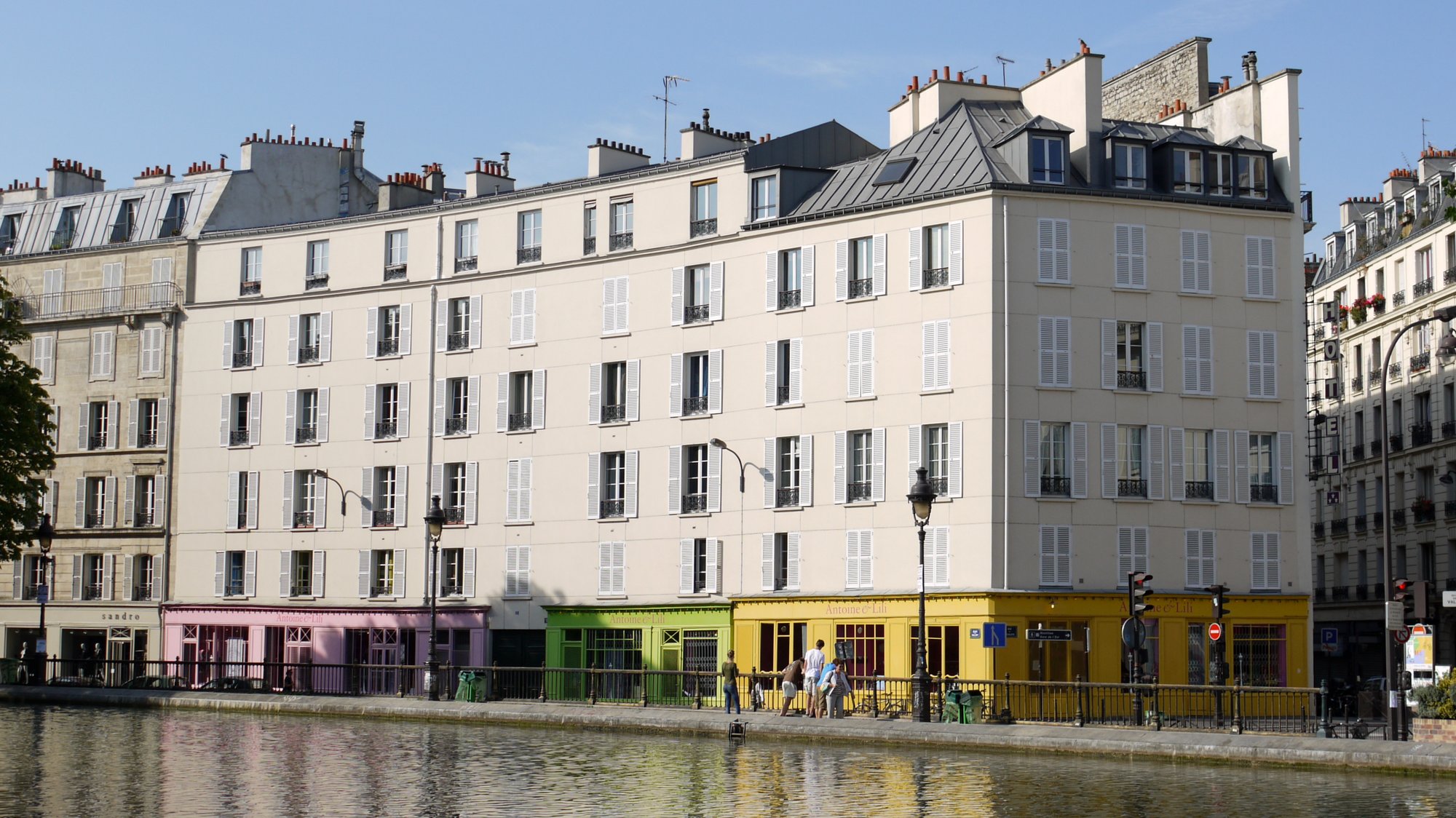
The locks of the Canal Saint-Martin: a mini engineering lesson
There are nine of them in total on the Canal Saint-Martin, between the Bassin de la Villette and the Seine. On our route, you’ll pass five before plunging under the vaulted tunnel at Place de la Bastille.
This is the magical moment for children. Watching a barge descend 25 centimetres inside a lock — waiting for the water to equalise — is well worth a ten-minute stop. Explain the principle of communicating vessels. You’ll see: they’ll keep asking questions for the rest of the ride.
The Grange-aux-Belles and Récollets locks are the most photogenic, with their cast-iron footbridges typical of the 19th century. These structures were built from 1805 on the orders of Napoleon, to supply Paris with drinking water. Today, they form part of the city’s historical heritage.
Going underground: the canal tunnel
From Place de la Bastille, the canal disappears beneath the buildings of the 12th arrondissement. For you, it’s straightforward: carry on along the surface, following boulevard de la Bastille, then take avenue Daumesnil heading east. The canal re-emerges at the Port de l’Arsenal — a lovely pocket of greenery and calm.
Avenue Daumesnil: the Promenade Plantée leads the way
Past the Bastille, the route follows avenue Daumesnil. This is where Paris reveals its most surprising face to cyclists. Above you, spanning the old arches of the Bastille railway line, stretches the Promenade Plantée — 4.5 km of elevated garden opened in 1993, well before New York’s High Line.
Down below, the cycle path runs alongside the Viaduc des Arts, home to craft workshops and galleries nestled within the old arches. No time to stop today — but make a note of it for a future outing without the cargo bike.
Practical note: the cycle lane on Daumesnil is wide and well marked all the way to the Porte de Vincennes. The surface is good; children can ride independently without close supervision. A few crossings with side streets still call for caution.
Nation: the roundabout that’s not as scary as it looks
Place de la Nation — the name sometimes puts family cyclists off. Needlessly so. Since the 2021–2022 redesign, the crossing is managed via clearly signed, protected lanes. Follow the signs for “Vincennes” and you’ll sail through without a hitch.
A drinking water fountain can be found at the Square du Trône, on the eastern side of the square — a good opportunity to top up water bottles if needed.
Bois de Vincennes: arriving in the forest
Past the Porte de Vincennes, the scenery changes completely. Tarmac gives way to forest paths, and the noise of the city fades gradually away. You’re now inside the 995 hectares of the Bois de Vincennes — Paris’s largest green space.
Lac Daumesnil, your final destination, is about 2 km from the entrance gate. Follow the signs for “Lac Daumesnil” — there are plenty of them, and they’re reliable. The circuit around the lake is 2.4 km, fully cyclable on flat, paved paths.
Lac Daumesnil: rest and picnic
Once you arrive at the lake, you’ll find several designated picnic areas with wooden tables and benches. On weekdays, it’s peaceful. At weekends, aim to arrive before 11am if you want a good spot.
The Île de Reuilly, reached by a pedestrian footbridge from the north bank of the lake, is home to a Guignol puppet theatre and a well-equipped playground — slide, swings, sandpit. For the children, this is the highlight of the day, easily outranking the locks.
Two refreshment kiosks surround the lake and are open in season (April to October): the lakeside guinguette serves sandwiches and cold drinks without breaking the bank. For a sit-down meal, tables are available under the plane trees on the south side.
Family variant: the Château de Vincennes route
If you still have energy after the picnic, a short ten-minute detour leads to the Château de Vincennes, a 14th-century royal fortress that brings to mind Mont-Saint-Michel, minus the tides. The keep, standing 52 metres tall, is visible from the lake on a clear day.
The grounds around the château include a vast esplanade, ideal for children to stretch their legs after cycling. Entry to the château is paid, but the exterior can be visited freely.
Practical information
Total distance: 22 km one way (allow 44 km for the return, or take the RER A from Vincennes — the station is a 5-minute walk from the lake)
Duration: 1h30 at a relaxed pace with children, including stops. Allow 2 hours if you linger at the locks
Elevation: virtually flat (a slight incline at the entrance to the Bois de Vincennes, entirely manageable)
Water points: - Place de la République (Wallace fountain on the boulevard Jules-Ferry side) - Square du Trône, Place de la Nation - Lake Daumesnil refreshment kiosks (in season)
Technical sections for cargo bikes: - Lock ramps on the Canal Saint-Martin (manageable, take care with a heavy cargo bike) - Crossing Place de la Nation (protected cycle lanes) - Entering the Bois de Vincennes via the Porte Dorée or Porte de Vincennes (both accessible)
Public transport: - Departure: Métro République (lines 3, 5, 8, 9, 11) - Return: RER A Vincennes or Nogent-sur-Marne
Final word
This is a route you’ll come back to. Not because it’s perfect — it isn’t. The canal banks can be packed on a Sunday afternoon, and avenue Daumesnil is still a main road, with its share of buses and delivery vans. But there’s something about the continuity of this route — this sense of crossing Paris from end to end without ever surrendering to the car — that makes it unlike any other.
With children in the cargo, you move from city to forest in 22 kilometres. They watch the locks, the barges, the centuries-old trees of the Bois. It’s a good day.
— Samir K.