Weekly Grocery Runs by Cargo Bike: Organisation and Equipment
Eighteen months ago, I did the calculation that every committed cyclist makes before finally taking the plunge: how many car journeys are actually grocery runs? In my case, the answer was embarrassing. Eighty per cent. Eighty per cent of my motorised kilometres went back and forth between home and the grocer’s, the market, the supermarket. With an electric cargo bike — a Tern GSD longtail, specifically — I decided to restore these journeys to their proper scale: fifteen minutes by bike, not forty minutes by car with the parking on top.
Eighteen months on, here is what I have learnt. What works, what does not, and what the brochures never tell you.
Real Payload vs. Theoretical Payload
Cargo bike manufacturers are optimists. My Tern GSD advertises a load capacity of 200 kg, which includes the rider. On paper, that is impressive. In the reality of a family of four doing a week’s shopping, it is a different story.
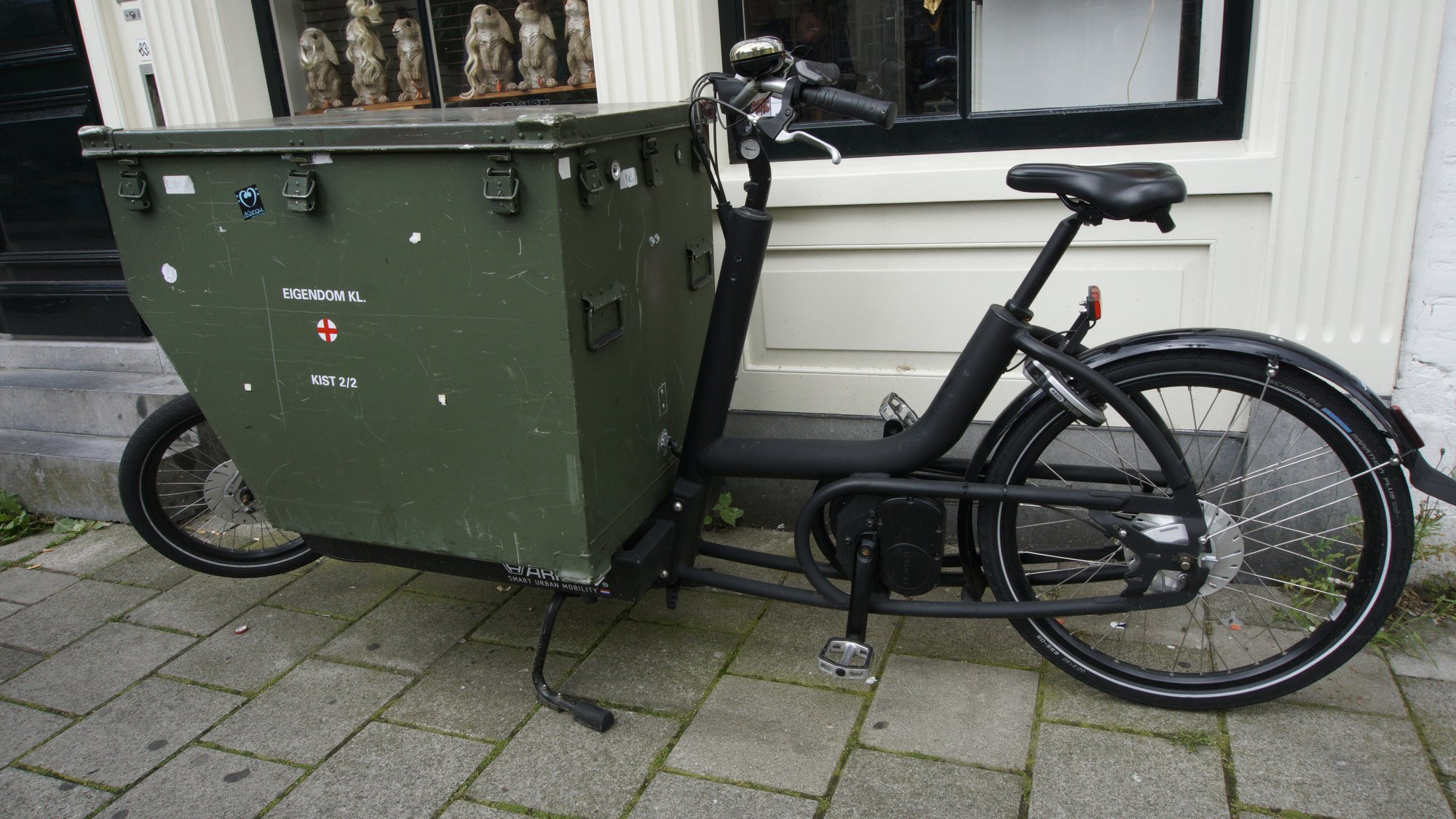
The real payload — what you will actually carry without the bike becoming unmanageable on hills — is around 40 to 60 kg for a standard longtail. On a front-loading cargo bike such as the Riese & Müller Packster or the Babboe City, the front box offers more generous volume, but weight remains the main constraint once you load up water containers, tinned goods, or bulk rice.
My rule of thumb after eighteen months: never exceed 50 kg net payload on a longtail, and always distribute the weight as low and as centred as possible. Low-mounted panniers are your best friends — high baskets turn your bike into a pendulum.
Panniers vs. Boxes: What Actually Holds Up
I have tried everything. Ortlieb waterproof panniers (robust, practical, but limited in volume), plastic crates fixed to the rack (maximum capacity, but with no decent attachment system), wicker baskets (charming, useless in the rain), and finally polypropylene crates of the Reisenthel type with lids.
The conclusion is clear: for grocery shopping, rigid lidded crates win every time. Here is why:
- They protect fruit and vegetables from knocks and rain
- They can be placed directly on the kitchen worktop
- They stack neatly for storage
- Standard sizes (40 × 30 × 20 cm) fit the racks of most longtails
I routinely carry two 30-litre crates plus a Reisenthel Coolerbag XL insulated bag for fresh produce. This system easily covers a week’s shopping for four people, provided the runs are planned sensibly.
Covered Markets and Supermarkets with Cycle Parking
Paris still has uneven infrastructure for loaded cyclists. The good news: it is improving. The less good news: finding a rack large enough to secure a longtail remains an adventure.
A few spots validated after eighteen months of riding in Paris and the inner suburbs:
- Marché d’Aligre (12th arrondissement): cargo bike racks at the entrance to the Beauvau covered market hall, on the Rue d’Aligre side. Covered market for rainy days, excellent local producers.
- Marché de Belleville (11th/20th): long pavement allowing you to pull the cargo alongside, stallholders accustomed to cyclists.
- Monoprix Beaubourg (4th): one of the few Monoprix stores with cargo racks on the Rue Beaubourg side — worth confirming given ongoing works.
- Grand Frais Saint-Denis: covered cycle parking at the entrance, generously sized racks.
My general recommendation: favour neighbourhood markets over supermarkets. Not for ideological reasons, but because the logistics are infinitely simpler. You load directly from the stall, talk to the vendor, choose what is ripe. The result: less waste, less unnecessary weight, and shopping that takes 45 minutes instead of 90 in a supermarket.
Organising Shopping for a Family of Four
Organising a week’s cargo bike shopping for four people requires a slight mental restructuring. Not a revolution — an adaptation.
The three-shops-a-week rule works well in our family:
- Monday morning: market for fruit, vegetables, cheese, eggs — 2 full crates, around 20–25 kg
- Wednesday: dry goods (pasta, rice, tinned food, oil) — the heavy run, 30–40 kg, on flat roads if possible
- Friday evening: fresh top-up, bakery, fishmonger — light load, 10–15 kg
This organisation avoids the classic beginner’s mistake: trying to do everything in one trip and arriving home with a 70 kg bike that refuses to climb the hill on Rue de Ménilmontant.
Synchronised digital shopping list: we use a shared app (Bring! in our case) so that every family member can add items in real time. This prevents unnecessary return trips and allows us to plan the crates according to the estimated volume.
Bulk and Heavy Items: What We Have Learnt
Bulk buying is the cargo bike’s friend. Zero-waste bulk shops such as Day by Day (present in several Paris arrondissements) are perfectly suited to the cargo format: bring your own containers, weigh, fill. No packaging, predictable weight, controlled volume.
But some products still pose challenges eighteen months in:
- 6-litre water containers: avoid them. Their weight-to-volume ratio is dreadful for a cargo bike. Solution: domestic water filter (Brita or under-sink filter), purchase eliminated.
- Bags of pet food (10–15 kg): possible to carry but uncomfortable over longer distances. We now order these for direct delivery.
- Cases of wine: 12 bottles ≈ 15 kg. Feasible, but position them as low as possible on the rear rack.
- Watermelons in summer: a logistical nightmare. An 8 kg watermelon rolling around in an open crate is a risk to your toes. A net bag is non-negotiable.
The main lesson: think about the volume-to-weight ratio before you set off. A 30-litre crate of organic cereals weighs 8 kg. An identical crate of tinned goods weighs 25 kg. The logistics are not the same.
What We No Longer Do by Car Since Getting the Cargo Bike
Eighteen months of practice, and the list has grown well beyond grocery shopping. Here is what has definitively left the car’s remit:
- All grocery shopping, without exception, whatever the weather (we have proper wet-weather kit)
- Pharmacy and parapharmacy runs — the cargo easily absorbs bulky orders
- Transporting plants and gardening equipment — the front box of a cargo bike is a paradise for garden centre trips
- Delivering parcels to neighbours — a neighbourly service that builds community ties
- School run combined with shopping — longtail with a child seat at the back, shopping at the front
What remains in the car? Trips beyond 30 km, house moves, IKEA flat-pack runs (though — some cyclists I know have attempted even those). And that is it.
Conclusion: The Cargo Bike as Infrastructure
The cargo bike is often spoken of as a gadget, a trend, a Scandinavian luxury. After eighteen months of daily use, I see it differently: it is domestic infrastructure, on a par with the refrigerator or the washing machine.
The initial investment is real — a quality electric longtail runs between €3,000 and €6,000, a front-loading cargo bike between €4,000 and €8,000. But the cost of running a car in the city (insurance, parking, fuel, maintenance) far exceeds these figures over five years. And no one will ever ask you to justify buying a car.
My final recommendation, as an architect who thinks in systems: start by renting a cargo bike for a month before buying. Paris has several long-term hire services. Test your family logistics, identify your real constraints, then invest with full knowledge of the facts. Good decisions are made with data, not enthusiasm.
— Ingrid S.