Six Months Car-Free: What Really Changed
Six months ago, we sold the family car. A grey Peugeot 308, seven years of good and loyal service, permanently parked 200 metres from our flat in the 11th arrondissement. We used it two, maybe three times a week. The rest of the time, it cost us: insurance, parking, an imminent MOT. My daughter Astrid, aged 8, had never seen me drive without spending twenty minutes looking for a space.
I grew up in Copenhagen. On a bike, obviously. Having lived in Lyon for eight years, then in Paris for two, I’d eventually succumbed to Parisian logic: the car as a safety net, as a permanent Plan B. What I’ve learnt over the past six months is that this safety net was nothing more than a comfortable illusion.
Day 1: The First Real Downpour
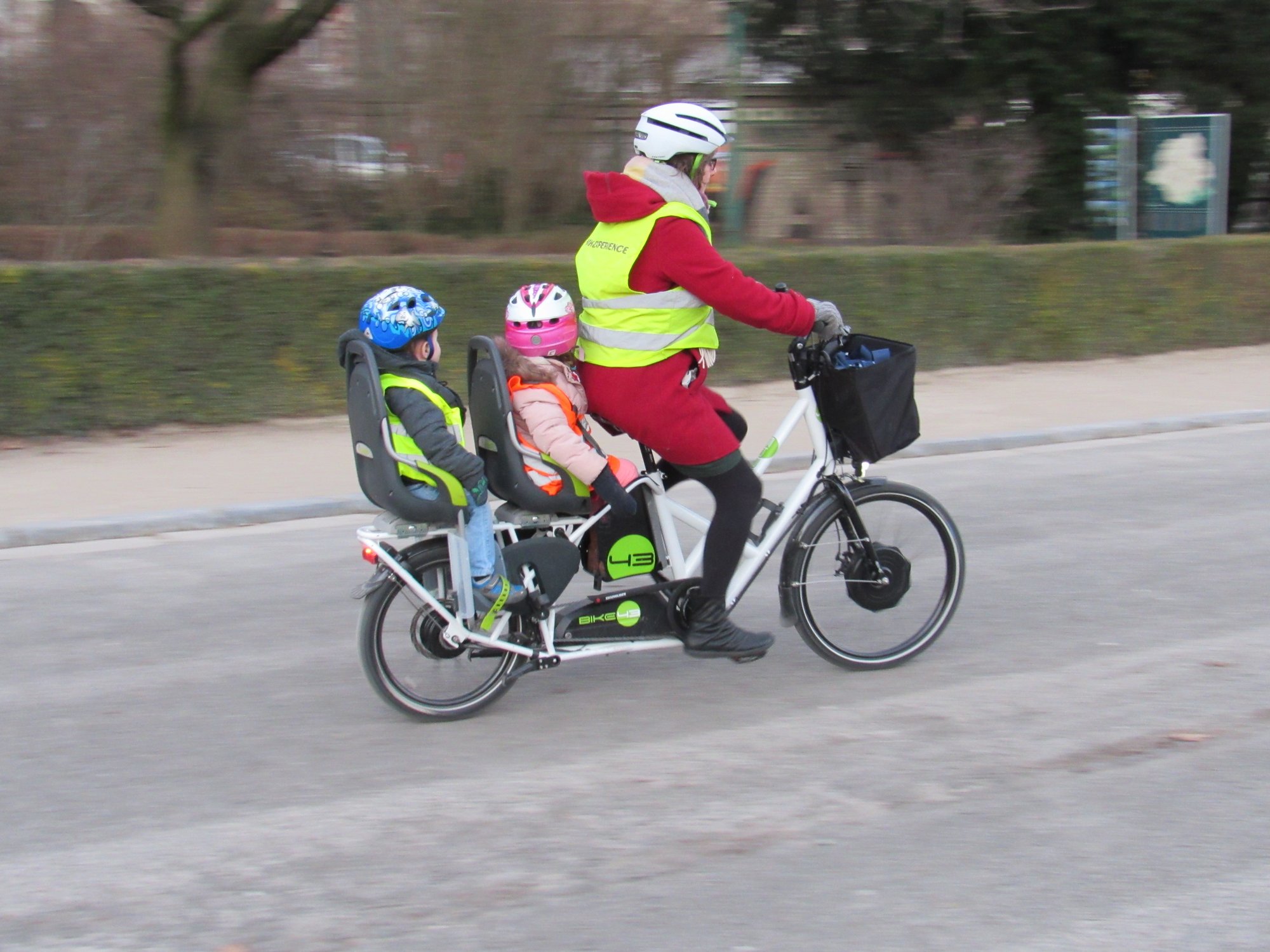
We bought the cargo bike — a Riese & Müller Packster 70 — in September. Electric, with a front box that fits two children and their bags. It was delivered in fine weather. So was the first week, as if Paris was testing us gently.
Then, on a Tuesday morning in early October, the sky collapsed.
Astrid and Théo (aged 6) were already in the box, in waterproof all-in-ones. Me, hood pulled tight over my head, cycling along Boulevard Richard-Lenoir wondering what I’d done. A taxi overtook me and splashed my right leg up to the hip. Théo laughed. Astrid told him it was “like being in a submarine”. They arrived at school dry. I did not.
That day I understood two things: children don’t mind the rain when they’re properly kitted out, and adults need a little more time to unlearn their fear of bad weather.
What We Thought Impossible — And Now Do Without Thinking
The list is long. I’ll set it out without excessive irony, because we genuinely believed it:
Grocery shopping. We thought we couldn’t do the shopping without a car. We now do two grocery runs a week by bike, with 40-litre panniers on each side. For the bigger orders — the 25 kg bag of flour my husband orders every two months for his homemade bread — there are deliveries. The cargo bike carries up to 50 kg of payload with ease.
Weekends. We thought we needed the car to “get away”. We now take the RER or train with the bikes. Last June (before we sold the car), we’d spent 1 hour 45 minutes driving to Versailles on a Sunday morning. In April, we went by train: 35 minutes, arriving refreshed, folding bikes propped in the corridor.
Emergencies. That was our great fear. Well: in six months, one real emergency — Théo, tonsillitis, temperature of 39.5°C. We took an Uber. Journey time: 12 minutes. Cost: 8 euros. The car, for its part, was costing us 280 euros a month in insurance and parking.
What Other People Think
Here’s something nobody had warned me about: arriving at the school gates on a cargo bike changes the social dynamics entirely.
In the first few weeks, I received well-meaning condescension. “Oh, you do cargo bike? How brave.” (Translation: you’re either idealists or masochists.) Then came the curiosity: “Does it really cope on cobblestones?”, “Aren’t you scared of lorries?”. And finally, gradually, something that looked rather like admiration — or at least respect.
Two families in the neighbourhood have bought a cargo bike since September. I claim no credit for this: they’d already been thinking about it. We perhaps simply made the idea feel a little less abstract.
The condescension, however, persists in certain contexts. A brother-in-law at the Christmas dinner table: “But what do you do for holidays?” Same as everyone else: train, plane, hire a car when necessary. Occasional rental costs far less than permanent ownership.
The Trips We’ve Given Up
A car-free life does involve trade-offs. Better to be honest about that.
We’ve given up regular visits to my in-laws in the outer southern suburbs — 35 kilometres away, reachable only by car for the last 8 kilometres. We go four times a year now instead of ten, hiring a car for the weekend. The relationship hasn’t suffered; the visits have perhaps become more intentional.
We’ve given up spontaneous Sunday outings of the “let’s see where we end up” variety. What we’ve gained in their place: better-planned outings, often more rewarding. The Fontainebleau forest by train. Leisure parks reachable by RER. Inner Paris rediscovered neighbourhood by neighbourhood.
We’ve also given up the ease of leaving transport decisions to the last minute. It requires more organisation. Honestly? After six months, I no longer feel it as a constraint.
What Our Children Have Gained
This is the part of the balance sheet I hadn’t anticipated.
Astrid and Théo now spend around forty minutes a day outdoors, on the school run. They see Paris. They see the markets, the building works, the pigeons, the café terraces. They hear the city. Before, they saw the inside of the Peugeot and listened to the radio.
Théo has learnt the names of six streets in the neighbourhood. Astrid now knows that the Canal Saint-Martin passes beneath Place de la Bastille (a piece of information she conveyed to her teacher with barely concealed pride).
They sleep better. That’s subjective, I know. But the paediatrician we consulted in January confirmed that daily exposure to natural light and moderate physical activity have a documented impact on children’s sleep quality. According to a study published by ANSES in 2023, the air quality inside a car is often lower than that measured outdoors, even in urban environments.
My daughter said to me one evening: “Maman, I like going to school by bike because we talk to each other.” In the car, we used to put music on.
The Financial Reckoning at Six Months
Let’s look at the figures, because they deserve to be set out clearly.
Costs in the old situation (car): - Insurance: €95/month - Parking (rented garage space): €180/month - Fuel (estimate): €80/month - Annual servicing averaged out: ~€50/month - Total: approximately €405/month
Costs in the new situation (cargo bike + public transport): - Cargo bike loan repayments (new Packster 70: €6,800, 36-month loan): €195/month - Bike maintenance (annual service, tyres): ~€15/month - Occasional car hire (4 weekends/year): ~€25/month averaged out - Navigo pass top-ups and public transport: €20/month - Total: approximately €255/month
Monthly saving: €150. Over a year, €1,800. The cargo bike will be paid off in 36 months. Once that milestone is reached, the annual saving will approach €3,600.
These figures don’t account for the car’s resale value (€4,200, partly used as a deposit on the bike), nor the parking fees avoided during trips around the city.
In Copenhagen, I grew up in a city where this calculation is obvious to everyone. In Paris, it remains counter-intuitive for many people. Perhaps because no one ever really lays the figures side by side.
Six Months On
We won’t be going back. That’s not an ideological stance — well, not only. It’s a practical, financial, and family conclusion.
The cargo bike isn’t a universal solution. It requires living in a city that is sufficiently dense and cycle-friendly, having an initial budget (though subsidies do exist — the French government’s cargo bike grant can cover up to 40% of the purchase price, capped at €3,000), and a willingness to unlearn certain ingrained habits.
But for a Parisian family whose daily journeys fall within a 15-kilometre radius, the question is no longer really “is it possible?”. It is: “Why didn’t we do this sooner?”
This morning it was raining again. Théo said he wanted to be “captain of the submarine bike” when he grows up. Astrid rolled her eyes. I smiled beneath my hood.
— Ingrid S.