After six episodes dissecting the subject from every angle — costs, manoeuvrability, storage, safety, electric or not — here comes the moment of truth. Julie asked me last week: “Thomas, if a parent has been reading along since the beginning, what concrete conclusion do they leave with?” Fair point. Because a guide that ends with “it depends” deserves to be thrown into the Seine.
So here we go. No woolly nuance. Real profiles, clear-cut recommendations.
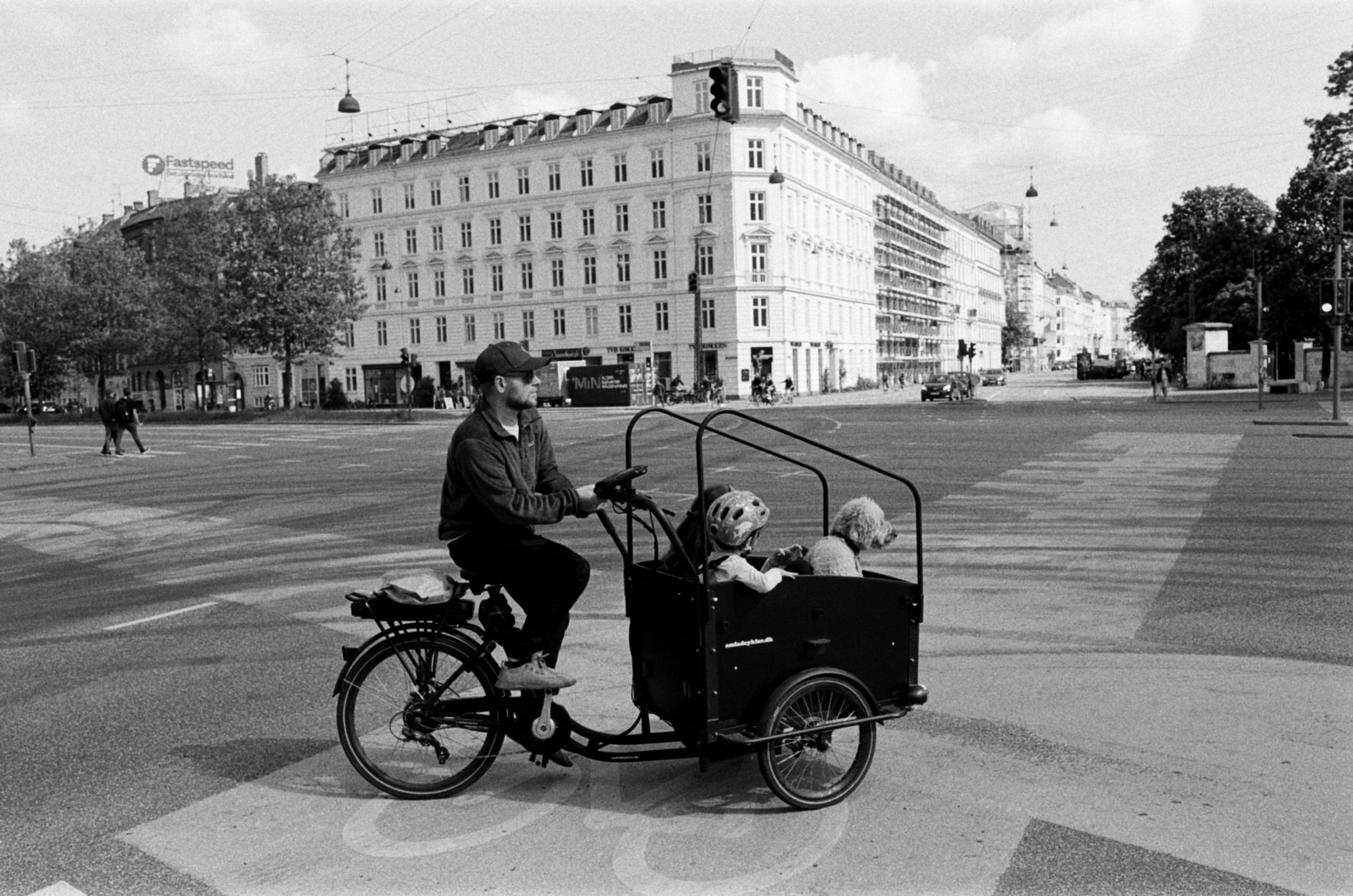
Profile 1: baby + young child, tight budget
The situation: You have a 14-month-old baby and a 4-year-old. You live in the 12th arrondissement, you have a cellar but no room in the hallway. Your bike budget is 600–800 € maximum.
Our verdict: trailer.
I know, I know — the cargo bike is prettier, more practical day to day, turns heads at traffic lights. But with a baby under 12–18 months, most cargo bikes aren’t suitable without specific accessories (approved seat, padding, etc.), which pushes the cost up considerably. On this budget, a second-hand Thule Chariot or Burley trailer in good condition costs 300–500 €. It folds up, fits under a bed or in a cellar in thirty seconds. It accepts babies once they can hold their head up (with the right harness), and the 4-year-old has plenty of room.
It’s not perfect. Léa hated the cobblestones of the Marais in our old trailer — the jolts, the summer heat, the feeling of being stuck at the back. But it’s doable, safe, and won’t break the bank.
Questions to ask yourself: Do you have a roadworthy bike to tow with? (Essential — a loaded trailer behind a battered bike is dangerous.) Can the baby really hold their head steadily?
Profile 2: two primary school children, difficult storage
The situation: Your two children are 6 and 9. You live in a Haussmann-era flat with no lift and no cellar. The hallway is 80 cm wide.
Our verdict: electric longtail.
Forget the triporteur or the classic front-loading cargo bike. You have nowhere to put it. Carrying an Urban Arrow up to the fourth floor with no lift is the kind of adventure that ends in A&E or a tribunal.
A longtail such as the Tern GSD or the Yuba Spicy Curry can slide down a narrow hallway, be carried upstairs with a bit of elbow grease, and carry two children on the back with ease up to ages 12–14. Electric assistance is strongly recommended here: with two children of that age (roughly 50–60 kg combined), Parisian gentle inclines become Alpine climbs without a motor.
Milo, my 5-year-old, loves riding on the back of the longtail. He turns around and waves at everyone — a disaster for my concentration, an absolute delight for his ego.
New price: 3,500 to 5,000 €. Velab in Paris offers test rides and long-term rentals if you want to try before you buy — I warmly recommend this step.
Profile 3: large family, long distances, electric option in mind
The situation: Three children — a 13-year-old teenager, an 8-year-old, and a 5-year-old. You live in Vincennes or Montreuil and work in the 9th arrondissement. The school-work commute is easily 8–10 km each way.
Our verdict: long-range electric cargo bike or electric cargo trailer.
This is the serious category. A front-loading cargo bike like the Babboe City-E or the Christiania with electric assist can carry the two younger ones in the front box, while the teenager follows on their own bike or takes the Métro. Current battery ranges — 60 to 80 km depending on the model and load — are more than sufficient for daily 10 km commutes.
A cheaper alternative: a two-seat cargo trailer (Croozer Cargo, Thule Courier) towed by a good electric bike. It’s less convenient than an integrated cargo — the children are behind you, not in front — but it costs two to three times less and can attach to a bike you may already own.
A word of caution on long distances with a trailer: beyond 8–10 km regularly, fatigue accumulates even with assist. The integrated cargo bike is more comfortable for everyone in the long run.
Budget for an electric cargo bike: 4,000 to 8,000 €. Subsidies are available via Véligo Location (long-term rental with subsidised purchase option in Île-de-France).
Profile 4: solo cyclist who also wants to take the kids at weekends
The situation: You’re a regular cyclist with a good road or city bike. At weekends, you want to take your 7-year-old son or 10-year-old daughter out for rides. During the week, your bike stays a solo bike.
Our verdict: trailer or detachable longtail seat.
This is where the trailer shines. It detaches in two minutes, your bike gets its soul back as a solo machine, and at weekends it reappears for family rides. A Burley Bee or a Thule Coaster XT costs between 350 and 600 €, carries one child up to 40 kg, and can even double as a jogging buggy with the right kit.
Another option: a seat such as the Yepp Maxi or Thule Yepp Nexxt on the back of your bike. Limited to one child, ideal up to ages 6–7. Simple, inexpensive (150–300 €), no bulkiness.
A two-seat trailer is fine if you occasionally need to carry two children. But if it’s just for the odd outing, rent instead — Welgo Bike offers cargo bikes by the day in Paris, perfect for testing without commitment.
Questions to ask before visiting a dealer
Before you set foot in a shop — or open a second-hand listings tab at midnight — ask yourself these questions in order.
1. Where am I going to store it? This is the killer question. I’ve seen families fall for a beautiful triporteur and then find it chained up in the street for lack of space, slowly rusting. Measure your hallway, your cellar, your bike storage. A cargo bike that doesn’t fit in your home is a useless cargo bike.
2. How old are my children now — and in three years? A 2-year-old in a trailer will be 5 in three years and may have outgrown it. A cargo bike that accommodates two children up to age 15 changes the financial calculation entirely.
3. What journeys do I actually make — not the ones I imagine making? The real daily route, with real constraints: traffic lights, hills, narrow streets, parking. Not the ideal Sunday outing.
4. What is my total budget — purchase + insurance + maintenance? A top-of-the-range cargo bike at 5,000 € new can work out cheaper than a budget trailer replaced every two years, if you use it for ten years. Do the maths over the long term.
5. Have I actually tried one? There is no substitute for a test ride. A cargo bike has to be felt and learned. Before any purchase, insist on a test.
As we explained in our guide to cargo bike rental in Paris, several rental operators offer trial days for exactly this reason.
Where to try, hire, and get help in Paris
Rental with test rides
- Velab (Paris 4th): electric cargo specialist, personalised advice, short and long-term rental. A serious team — no sales pressure.
- Welgo Bike: daily or weekly cargo rental, several models available including family front-loaders.
- Bee.Cycle: cargo rental and leasing, good option if you want a full week’s trial before deciding.
- BikUp: peer-to-peer cargo rental platform, often more affordable rates.
For help and repairs
- L’Heureux Cyclage: network of participatory workshops across France, ideal for learning to maintain your bike yourself — particularly important when a cargo costs a fortune to service at a commercial mechanic’s.
Financial support
- Véligo Location: long-term rental subsidised by the Île-de-France region. Some cargo bikes are eligible — worth checking, as it can dramatically reduce your monthly outgoings.
Forums and communities
- The Facebook group “Vélo Cargo Paris” (search directly on Facebook) brings together hundreds of Parisian parents sharing reviews, tips, and sale alerts.
- The velodz.com forum and discussions on reddit.com/r/velo offer unfiltered real-world feedback.
What this series taught us
When I started writing these six episodes, I already had a firm opinion: cargo wins, full stop. Six months later, after speaking with trailer-using families, solo cyclists managing with a rear seat, and parents of large families juggling both — my answer is more nuanced.
The cargo bike is a comfort revolution. The trailer is a pragmatic solution. Both have their place. What determines the right choice is your real context: housing, children, distance, budget.
What I hope is that you’ll come away from this series with one thing in mind: there is a two-wheeled (or three-wheeled) solution for every Parisian family. The key is not to buy on impulse — or worse, to buy nothing at all because it seems too complicated.
Go on. Take the plunge. Rent first. Try it. And write to me if you have questions — I always reply.
— Thomas J.