The cargo bike rolls out of the hire shop. Two wheels, a hefty frame, a large front box or a long rear platform. That’s it. Everything else is yours to build. Child seat, rain protection, reinforced lighting, proper lock — every accessory deserves a real decision. Because a poor choice is expensive, heavy, and can even be dangerous.
Here’s what we learnt the hard way.
Child Seats: Certification First, Comfort Second
The first question parents ask: “Will my regular bike seat fit on the cargo?” Short answer: rarely.
Long-tail cargos (Yuba, Xtracycle, Riese & Müller Load 75) sometimes accept standard rear seats — Thule Yepp Maxi, Hamax Caress — provided the rack is certified to EN 14344. Check before you buy.
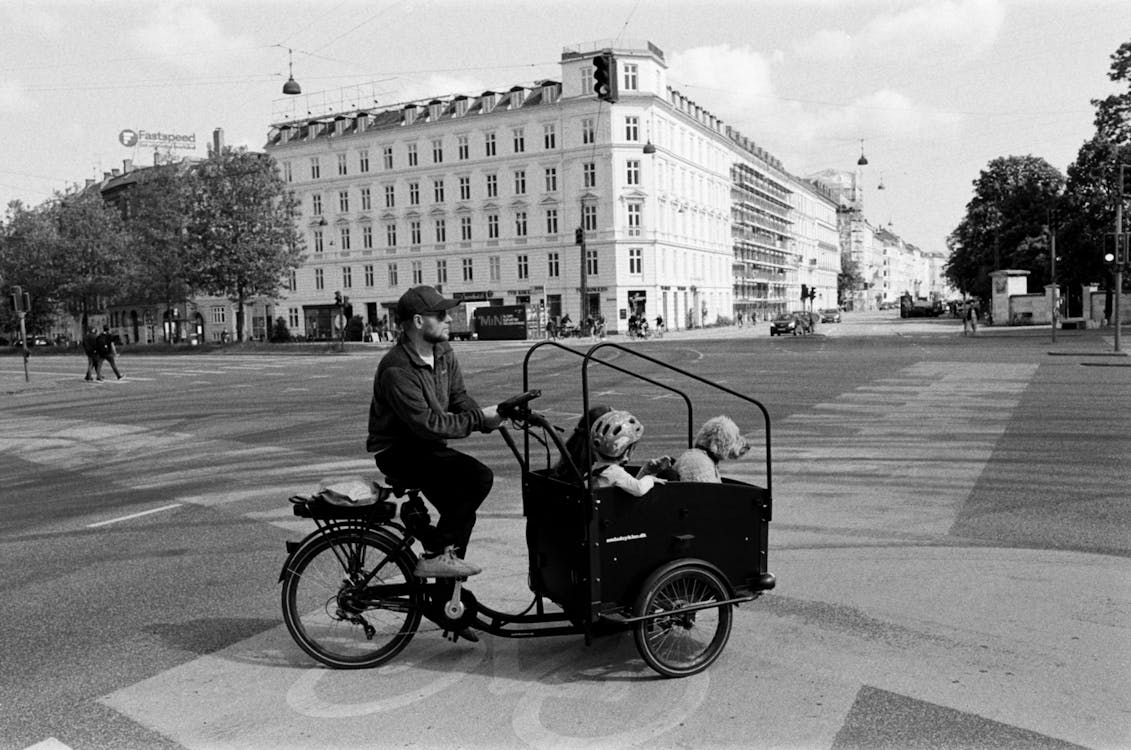
For longjohn cargos (front box, Christiania-style, Larry vs Harry Bullitt), dedicated seats are the norm. Danish brand Smiley makes moulded box seats with five-point harnesses compliant with CE EN 13209-2. The result: children stay put, no sliding, even over cobblestones.
What we tested: The Urban Arrow Family seat with integrated harness remains the reference for closed boxes. Two children aged 1 to 5, zero compromise. The downside? The price: around €350 as a purchase option, €280 as an add-on accessory.
What we’d avoid: Makeshift adapters, seats without EN certification, and above all seats clamped onto tubes not designed for the purpose. You see them around. Don’t do it.
Rain Protection: Integrated Cab vs. Added Rain Cover
Paris, November. Rain coming in sideways. You have two options.
The Integrated Cab
This is the premium cargo solution. Urban Arrow, Babboe Curve Mountain, Riese & Müller: their cabs are designed for the bike’s box, with waterproof zips, plastic windows and adjustable ventilation. They go on in under five minutes.
Advantage: the children are warm, dry, and usually delighted (the cab becomes a den). Disadvantage: it costs between €300 and €600, and significantly increases wind resistance — expect 20% more effort riding into a headwind.
The Added Rain Cover
An adjustable tarpaulin on velcro or elastics. An economical solution (€50 to €120), but less reliably watertight over time. The wind lifts it. The children unhook it. In light drizzle, it does the job. In a proper downpour, you’ll be disappointed.
Our verdict: If you ride more than three times a week, invest in the cab. If the cargo is occasional, the rain cover will see you through.
Lighting: What the Law Says (and What Reality Requires)
The rules of the road are clear. In France, every cycle must have a white light at the front and a red light at the rear, visible from 200 metres at night. For cargo bikes carrying passengers, the regulations don’t fundamentally change — but the sheer size of the vehicle creates additional requirements.
A cargo bike 2.5 metres long carrying children is barely visible at night if the only rear light sits at saddle height. Several manufacturers have taken note: Babboe and Urban Arrow now integrate additional lights at box level.
What we recommend: - Integrated dynamo lighting (ideal — no batteries to manage) - An additional rear light mounted on the box or rear bumper - Side reflectors on the wheels — legally required, frequently forgotten - For non-equipped cargo bikes: Busch & Müller offer adaptable dynamo kits, and Knog make powerful rechargeable lights (Blinder Road model)
To avoid: Small urban bike lights. Inadequate for such a wide vehicle. And illegal if not compliant with standard NF EN 13560.
Panniers and Boxes: Real Volume vs. Bulk
The cargo bike creates the illusion that you can carry anything. It’s true. But poorly organised, it becomes a rolling chaos.
Side Panniers
Ortlieb Back-Roller panniers (40 litres per pair) are the benchmark: waterproof, durable, quick-release on a standard rack. On long-tail cargo bikes, they sit along the platform sides without encroaching on the pedalling space.
A common issue: on some cargos, oversized panniers hit your heels while pedalling. Measure first. The golden rule: no more than 15cm overall width per pannier if the rack sits within 30cm of the bottom bracket.
Rigid Boxes
For families wanting closed, secure storage (sports bags, shopping, play equipment), rigid boxes like the Thule Cargo Box have been adapted by several accessory makers for cargo use. Practical, but heavy when empty (3 to 5kg) and they raise the centre of gravity.
Our experience: For daily life (school run, shopping), two 20-litre side panniers are more than sufficient. The rigid box is for camping weekends.
Locks: The Cargo Bike’s Size Changes Everything
A standard U-lock won’t secure a cargo bike. The frame is too large for most classic U-lock shackles. And a cable alone takes a well-equipped thief about 30 seconds with bolt cutters.
Solutions that work:
- Large-format U-lock: Kryptonite New York Fahgettaboudit Mini (with its extension cable) or Abus Granit X-Plus 540 — U-locks capable of going around a cargo tube and a fixed rack
- Heavy chain: Kryptonite New York Fahgettaboudit Chain (14mm, 150cm) — heavy (4.5kg) but essential if you leave your cargo outside overnight
- GPS alarm: Invoxia Bike Tracker or Boomerang Cyclotrac for electric cargos — real-time location, alert on movement
What we’d avoid: A single anchor point. Always use two locks, two separate fixing points. Thieves know cargo bikes are worth between €3,000 and €10,000.
The Useless Accessories We Bought Anyway
Let’s be honest. The excitement of new cargo kit is expensive.
The panoramic mirror. Good idea in theory. In practice, vibrations make it unreadable after 500 metres on cobblestones. We took it off.
The extra-loud bell. We thought an impressive cargo deserved an impressive bell. Pedestrians barely looked up. The standard bell is fine.
The extra baby seat “just in case”. For the second child not yet born. Two years in the garage. Don’t do it.
The rubber floor mat for the box. Sold as knee protection for children. In reality, it holds water and goes mouldy. A folded towel works better.
Conclusion: Kit Up Gradually, Not All at Once
The family cargo bike is an ecosystem. You don’t equip it in a single order. Start with the bare essentials: a certified seat, compliant lighting, a serious lock. Then add things as the seasons and uses reveal what you actually need.
The classic mistake: buying everything at once, on the basis of online reviews, without having ridden a single kilometre. The best accessory is the one you notice you’re missing after two weeks of real use.
And if you’re still deciding between a cargo and a classic bike with a trailer, start by testing. Paris hire shops offer several long-term rental options that let you live with a cargo bike for a week or a month before committing to a purchase. It’s the most honest way to find out what you genuinely need.
— Samir K.