There was a precise moment when I understood that an electric cargo bike wasn’t a gadget. It was a Tuesday morning, 8:15am, on rue de la Roquette. Sophie was 4, Léo was 2, the nursery bag weighed a tonne, and I had two shopping nets hanging off the sides of the bike. The assist kicked in the moment I pressed the pedal. And there — I’m not joking — I nearly burst into tears of relief.
But before reaching that point, I’d spent six months reading spec sheets, comparing range figures that meant nothing, and catastrophising about breaking down halfway. This article is everything I wish I’d known beforehand.
Real-World Range: Forget the Manufacturer’s Numbers
Manufacturers claim 80, 100, sometimes 120 km of range. These figures assume a lone rider on flat terrain with minimal assist. Real life is something else entirely.
With two children (32 kg combined), two bags of shopping (8–10 kg), and the inevitable rucksack, you’re loading the cargo bike to around 130–150 kg total. Under those conditions, here’s what you actually get with a 250W motor and a 500 Wh battery (the most common configuration):
- Assist level 1–2 (eco): 40–55 km in the city with moderate hills
- Assist level 3–4 (standard): 25–35 km
- Assist level 5 (turbo): 15–20 km maximum
Most Parisian families cover 5–8 km per day. Using mixed assist (eco on straight roads, sport on climbs), a single charge comfortably covers 4–5 days of daily commuting. That’s reassuring — and it’s often underestimated in reviews.
Models with a 750 Wh battery (such as the Babboe City Mountain E or the Riese & Müller Packster) offer 30–40% more range. For families who combine weekend outings with school runs, that extra investment is worth the price difference.
Charging in a Flat: The Real Constraints
Here’s the point nobody mentions clearly: charging an electric cargo bike in a flat requires planning.
Most modern batteries charge via a standard plug (220V, regular socket). The Bosch PowerTube 500 Wh, for instance, charges in 4.5 hours from flat. The Shimano STEPS E8000 with its 504 Wh battery: around 5 hours.
The battery detaches from the bike (on virtually all recent models — an absolutely essential criterion to check before buying). You carry the battery up to your flat, plug it in, go to sleep. In the morning, it’s full.
The practical pitfalls:
-
The distance between the bike storage and your flat. If you live on the fifth floor without a lift and storage is in the basement, carrying a 3–4 kg battery twice a week becomes either a habit or a chore, depending on your disposition.
-
Reluctant landlords and residents’ associations. Some ban charging in communal areas. A removable battery gets around that — you charge at home, full stop.
-
Charging time. One charge every 4–5 days under normal use. No need to plug in every night like a smartphone.
Practical advice: buy a second battery if you’re a heavy user (more than 50 km per week). Two batteries in rotation means total peace of mind. Budget 400–600€ depending on the model — pricey, but invaluable.
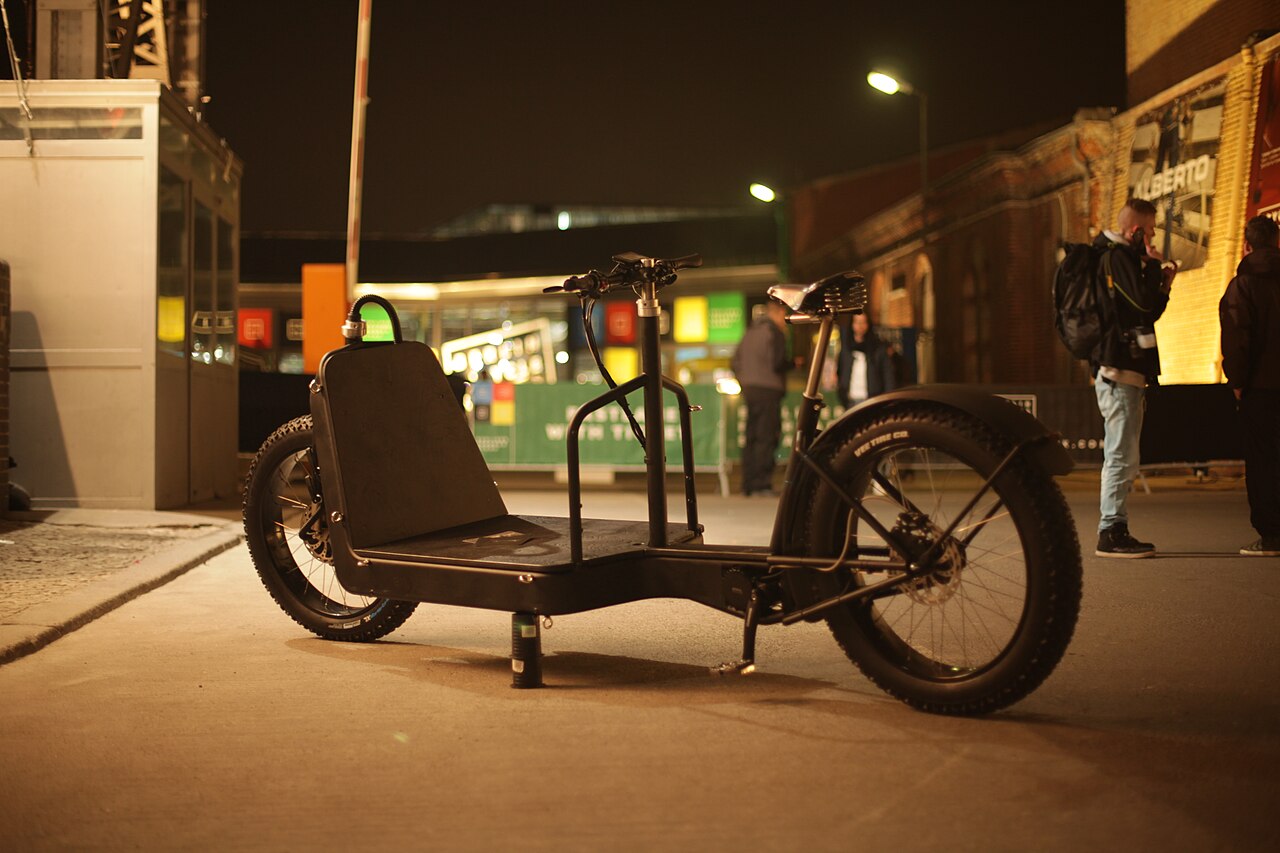
Total Weight: A Reality Worth Facing Head-On
An electric cargo bike weighs between 28 and 45 kg depending on the model. Add two children (say 35 kg), safety equipment (seat, harness, rain cover: 8 kg), shopping (10 kg): you’re at 80–95 kg of total load on the thing.
Without electric assist, this is simply unworkable in Parisian conditions. Even gentle hills become trials. Rue de Ménilmontant, rue de la Butte-aux-Cailles, any bridge whatsoever — every incline becomes a negotiation with your quadriceps.
With assist, the physics change completely. The motor compensates precisely for the extra effort required by the weight. On a 5% gradient, you pedal as though you were alone on a lightweight bike. This is where the technology genuinely delivers on its promise.
One small detail that makes a big difference: hydraulic brakes. With 90 kg of total mass rolling downhill, cable brakes hit their limits quickly. Hydraulic disc brakes, present on mid-range and premium models, are essential — not a luxury.
If you’re new to cargo bikes with children, our article on your first cargo bike ride with kids: what we wish we’d known covers exactly the practical aspects that product spec sheets ignore.
Battery Failure Halfway: What You Actually Do
This is the question that comes up in every parenting discussion: what if you break down with the children?
First, a technical point: modern systems (Bosch, Shimano, Bafang) have intelligent battery management. The charge indicator is reliable to 90–95% on recent batteries. Contrary to what you might imagine, failure doesn’t arrive without warning.
Then, the practical reality:
Scenario 1: battery at 15%, 3 km from home. You drop the assist to level 1 (eco), pedal a little harder, and get there. The bike remains perfectly rideable without assist — heavier, but manageable.
Scenario 2: total failure mid-journey. Rare, but it happens (faulty cable, electronic glitch). In that case: you call someone, or find a café where you can leave the bike while someone comes to collect the children. The bike can wait. French cities also have rental shops and workshops that can sometimes help in a pinch.
Prevention: recharge when the battery drops below 20%, not below 5%. Monitor your actual kilometre counter (not the estimated range — it varies with terrain and load).
And keep this in mind: total battery failure mid-journey with children is a scenario that’s frightening on paper but remains exceptional in daily practice.
Three-Year Cost: Electric vs Mechanical
An honest comparison, no filter.
Electric cargo bike (entry to mid-range)
| Item | Estimated cost |
|---|---|
| Purchase (e.g. Babboe City E, Yuba Spicy Curry E) | £3,000 – £4,500 |
| Annual insurance | £130 – £175/year → £390–525 over 3 years |
| Maintenance (services, cables, tyres) | £130 – £215/year → £390–645 over 3 years |
| Electricity (≈ £0.45/charge, twice a week) | ≈ £140 over 3 years |
| 3-year total | £3,920 – £5,810 |
Equivalent mechanical cargo bike
| Item | Estimated cost |
|---|---|
| Purchase (e.g. Babboe City, Winther Kangaroo) | £1,600 – £2,500 |
| Annual insurance | £85 – £130/year → £255–390 over 3 years |
| Maintenance | £85 – £155/year → £255–465 over 3 years |
| 3-year total | £2,110 – £3,355 |
The real gap over 3 years: £1,500 to £2,400.
Is it worth it? My honest answer: if you live in central Paris with hills, yes. The quality of life gained on climbs with two children on board justifies the investment. If you’re in a flat arrondissement and you’re fit, a mechanical cargo bike is a perfectly reasonable choice.
It’s also worth noting: the French government’s cargo bike bonus (up to €2,000, means-tested) and regional or municipal grants can significantly close the gap. In 2024, the cargo bike conversion grant was still active — check your eligibility before buying.
The Most Reliable Family Electric Models
I don’t do rankings — it’s not my style. But after testing, observing, and talking to dozens of Parisian cycling families, here’s what stands out.
For urban families (daily use, 2 children)
Babboe City Mountain E — The Dutch bestseller has earned its reputation. Bosch Performance Line CX motor, 500 Wh battery, solid wooden box. The strength: owner community and service network. The weakness: the weight (40 kg) makes itself felt when you have to carry the bike.
Urban Arrow Family — More premium, a more responsive Bosch motor, sportier geometry. Ideal if you have a daily commute of 10+ km. Price: €6,500 – €7,500. An investment, not an expenditure.
Yuba Spicy Curry Electric — The longtail (children behind, not in a box). More nimble in traffic, less cumbersome, but slightly reduced carrying capacity. Reliable Bosch motor.
For weekend rides + daily commuting
Riese & Müller Packster 70 — The heavy artillery. Dual battery possible, range up to 150 km in eco mode, impeccable German build quality. Price: €8,000 – €10,000. For families who are genuinely replacing a car.
What these models share: Bosch or Shimano motors (the two reliable references in 2024–2025), a dense repair network across France, and available parts. Avoid obscure motors with no service network — if something breaks, you’re on your own.
We also explored the practical organisation of daily life with a cargo bike in our article on weekly shopping by cargo bike: organisation and kit — worth reading if you’re in the decision-making phase.
Real Life with an Electric Cargo Bike
Three years after my moment of revelation on rue de la Roquette, here’s what I can say.
The electric cargo bike hasn’t made Parisian mornings magical. The children still cry sometimes, rain still catches you off guard, horns still irritate. But it has eliminated one source of stress — physical effort — which leaves energy to deal with everything else.
The range figures, once you truly understand them, stop being frightening. Charging becomes as natural as plugging in a phone. And the cost, spread over three years, is often less than the monthly parking fees for a car in central Paris.
What I hadn’t anticipated: the joy. Not the utilitarian satisfaction of transporting children. The pleasure of riding with them, hearing them discover the city from the box, watching their eyes light up as you cycle along the Seine. No taxi app has ever produced that.
Choose a reliable model, check the grants available, and start with short journeys to find your assist settings. The rest will come naturally.
— Marco B.