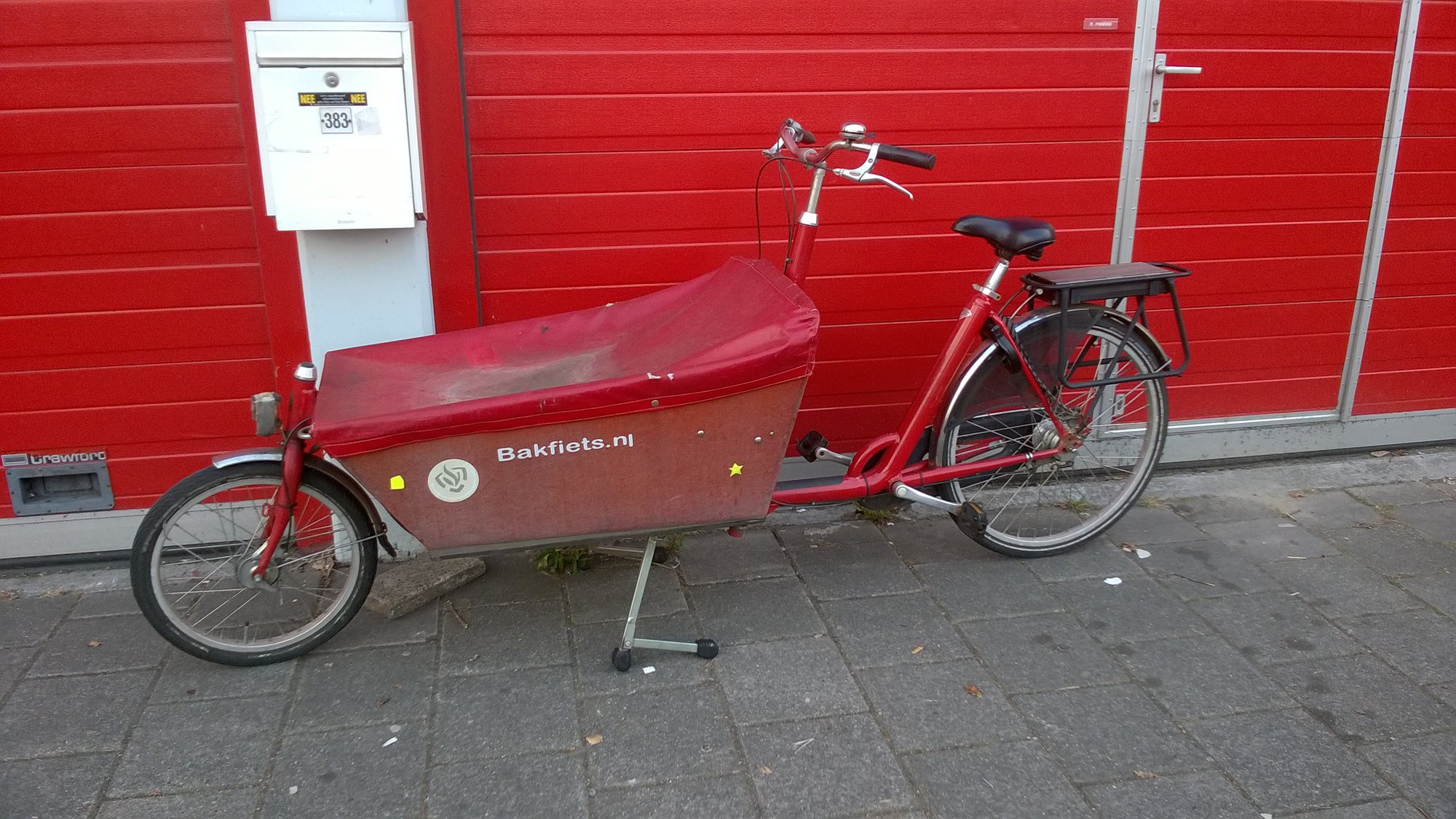
Some purchases are made with great enthusiasm, only to reveal their true nature at the first corner. The cargo box bike — a two-wheeled bicycle with a large front cargo box — is very much one of them. You see them popping up all over Paris these days: along the banks of the Seine, in the Marais, in the 11th and 20th arrondissements, parents pedalling proudly with their children nestled in the wooden or plastic box up front. The image is lovely. The reality, however, is rather more nuanced.
Over the course of several months, I had the opportunity to observe and speak with families using three of the leading models on the market: the Babboe City, the Christiania, and the Nihola Family. What I learnt is worth sharing — before you buy, not after.
The Underrated Advantage: Your Children Are Right in Front of You
The first argument that sellers typically make is the practical one — transporting two children without a car. That’s true enough. But what they mention less often is the quality of connection that this configuration creates.
In a cargo box bike, the children sit in the box, facing forward, right in front of you. You can see them at all times. You see their eyes go wide at a street market, you hear their commentary on passers-by, you notice their signals when they’re cold or starting to squabble. It’s a closeness that no rear child seat on a conventional bike can offer, let alone a car.
Older children (from around 4–5 years old) can climb in and out of the box themselves using the small integrated steps on certain models such as the Babboe City. Younger children are strapped in with a seatbelt or harness depending on the model. The Babboe City’s cargo box measures 99 × 64 cm — enough to comfortably seat two children, or even three with an additional bench.
Having your children permanently in your line of sight fundamentally changes the experience of the journey. It’s no longer merely transport — it becomes shared time.
Width in the City: The Blind Spot in Every Brochure
The Babboe City measures 65 cm wide — almost the same width as a standard bike with handlebars extended. The Nihola Family comes in at 89 cm owing to its larger cargo box. As for the Christiania Light, it varies between 58 and 99 cm depending on the model.
These figures seem unremarkable on paper. They take on an entirely different significance in the reality of Parisian streets.
Narrow Passages
Paris is a city of corridors. The carriage entrance gates (portes cochères) of Haussmann-era buildings — those grand 19th-century apartment blocks that make up much of the city — often have a useable passage width of 80 to 90 cm, sometimes less if shutters or meter boxes encroach. Some bicycle storage entrances, cobbled alleyways in the Marais, and covered passages are no wider than 70 cm. With a Nihola (89 cm wide), certain passages are simply impassable.
The Babboe City fares better thanks to its more modest width, but even at 65 cm, one must plan ahead. Weaving between two tightly parked cars doesn’t come naturally the way it does on a folding bike.
The Métro
There’s no point hoping to take a cargo box bike on the Paris Métro. The barriers are sized for folded bicycles or luggage — not for a box measuring at least 65 cm. The question barely arises in practice, but some owners hope to use ramps or walkways in stations: this is generally impossible.
The Building Entrance
This is often where the dream comes to grief most brutally. If you live on the third floor with no suitably large lift, or in a building whose entrance corridor is 70 cm wide, you simply will not be able to bring your cargo bike inside. You’ll have to park it outside — with all the theft risks that implies in a major city.
The Parisian Lift: In or Out?
This question comes up constantly in cycling parents’ forums: can you take a cargo box bike up in a Parisian lift?
The honest answer is: rarely.
Lifts in Parisian buildings constructed before 1970 — which is to say the vast majority of the Haussmann-era housing stock — measure between 60 and 80 cm wide internally, with a depth of 80 to 100 cm. A Babboe City is 255 cm long by 65 cm wide: the length alone is a deal-breaker. No cargo box bike model will fit upright into a standard Parisian lift, let alone with children still inside.
A few solutions exist: some owners store the bike in the cellar or a ground-floor bicycle room (where one exists), others have arranged a secure outdoor parking spot with a dedicated anchor point. The Paris city council offers subsidies for installing private bicycle anchors, and several arrondissements have developed secure cycle lockers.
In practice: before buying a cargo bike, sort out your storage solution first. This is the first question to resolve, not the last.
Braking Under Load: Those First Descents Are Frightening
A cargo bike loaded with two children (say 25–30 kg of children, plus school bags, plus the bike itself which weighs between 35 and 55 kg depending on whether it’s electric or muscle-powered) represents a total moving mass of 90 to 120 kg.
The Babboe City-E is fitted with hydraulic disc brakes front and rear, which is reassuring. Even so, getting used to it is unsettling at first. Several parents report the same experience: the first time you come down a hill at any speed with children in the box, you feel a sudden surge of inner panic. The inertial mass is unlike anything you’ve experienced on a bicycle before.
The Christiania, in its non-electric versions, requires an even longer adjustment period. Its unladen weight can reach 34 kg (Light model) — before children, before shopping. Braking properly before a busy junction with 100 kg rolling beneath you requires a level of anticipation that doesn’t come naturally in the first few days.
What to Do Before Taking to the Roads
- Ride unladen first, then add progressive ballast
- Avoid steep descents for the first two weeks
- Check cable tension and brake pad condition regularly
- Opt for models with hydraulic brakes for intensive use
The Nihola Family, incidentally, is a trike (three wheels) — technically different from a two-wheeled box bike, even though the two are often confused. Its stability when stationary and at low speed through corners is superior, but its 89 cm width and manoeuvrability in dense urban traffic are more demanding.
Babboe City, Christiania, Nihola: Three Philosophies
Babboe City — The Pragmatic Dutch Option
Designed in the Netherlands, the Babboe City is the best-selling cargo bike for urban families in Europe. Its birch wood cargo box (99 × 64 cm), contained width (65 cm), and reasonable weight (around 35 kg in the muscle-powered version, 45 kg electric) make it the natural candidate for Paris. The electric version (City-E), with a Bosch or Yamaha motor, removes the effort on bridges and inclines — and Paris has plenty of both. Price: between €1,500 and €3,500 depending on the version.
Christiania — The Danish Soul
Born in the free commune of Christiania in Copenhagen in the 1970s — a legendary, self-governing neighbourhood in the Danish capital — this bike has a history and an aesthetic that the Babboe simply doesn’t have. More handcrafted, heavier, but also more robust. Its solid wood construction inspires confidence. Several models exist (Classic, Light, +30), with varying widths. It suits families who have the space to store it and who appreciate the object as much as its function.
Nihola Family — The Scandinavian Trike
The Nihola is technically a trike, with two wheels at the front. Its stability when stationary is incomparable — no kickstand needed, the bike stands on its own. Ideal for loading children calmly, for stopping in double-parked positions, or waiting outside the school gates. Its 89 cm width, however, makes it a imposing machine in Paris’s narrower streets. The Nihola Family was named the best children’s cargo trike by the Danish newspaper Politiken and the Dutch cycling organisation Fietsersbond. Price: around €3,000 to €4,500.
What We Wish We’d Known Before Buying
Here are the questions that almost nobody asks — and that sellers rarely volunteer:
1. Where will you park it overnight? This is the number one question. If you haven’t got a secure ground-floor solution, the adventure may come to an abrupt end by the first winter.
2. Do you have a child under nine months old? No cargo box bike is suitable for infants who cannot hold their head up. Wait until the child can sit up comfortably on their own — around 12 to 15 months depending on development — before putting them in the box.
3. What does your daily route look like? If your journey includes cobbled streets, significant hills, or narrow passages, some models are better suited than others. A scouting ride on your usual route before you buy is strongly recommended.
4. Have you tried the model fully loaded? Insist on a test ride with ballast equivalent to your children’s weight. Several specialist shops in Paris offer test rides — notably Cyclable and a number of independent bike shops in the 11th and 13th arrondissements.
5. Electric or muscle-powered? In Paris, with children on board, the answer is almost always: electric. The difference in comfort on the bridges (Bir-Hakeim, Sully, Austerlitz) and the climbs up to Belleville or Ménilmontant is considerable.
Conclusion
The cargo box bike is neither a toy nor an incompatible fantasy for Paris living. It is a powerful tool that demands preparation, a degree of adaptation, and honest reflection on one’s own circumstances.
Families who adopt one successfully almost all share the same attributes: ground-floor storage, a relatively flat route or electric assistance, and a few weeks of progressive practice before diving into heavy traffic.
Those who come to regret the purchase have typically bought on impulse, without thinking through the parking situation, without testing the bike loaded, and without measuring their front door.
The good news: the second-hand market is active, and long-term rental is beginning to develop in Paris — allowing families to test over several months before committing. A sensible caution, and a much better approach than blind enthusiasm.
— Henri D.