There comes a moment in every cycling family’s life when the question arises. Not in the abstract — very concretely, on a Tuesday morning, when the second child is too big for the rear seat and the third rucksack refuses to fit in the pannier. That moment is the beginning of a real decision.
A decision that deserves more than an hour of forum scrolling. A decision that calls for stopping, looking at your life as it actually is — not as you’d like it to be — and asking the right questions in the right order.
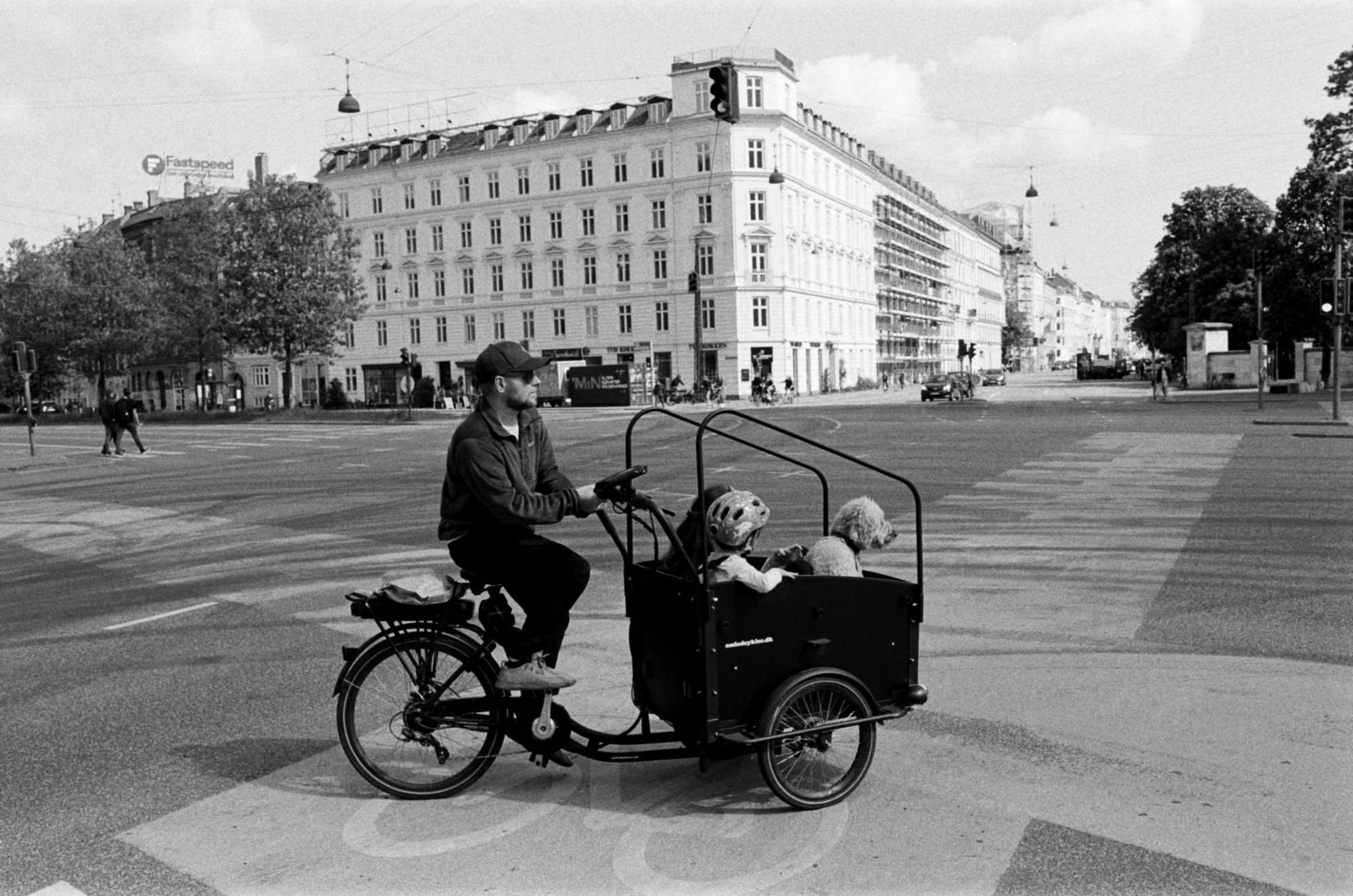
Before the Models: Your Family’s Profile
The first mistake is starting by looking at bikes. Before the bikes, there are the children. Their age, their weight, their temperament — and what their days actually look like.
How Many Children, and How Old?
An 18-month-old and a 7-year-old are not the same transport problem. The younger one needs an approved seat with a protective shell, a low frame for easy loading, a space where they stay still. The older one might want to pedal halfway — or fall asleep mid-route.
The rough rule of thumb: - 0–4 years: seat or closed box (box-front cargo bike). They can’t hold on unaided; they need containment. - 4–8 years: open box possible, but with a harness. They move, they lean, they let go at the wrong moment. - 8 years and up: cargo bike bench or longtail. They can hold on and appreciate the space. - Several children of mixed ages: the closed box offers the greatest flexibility.
A trailer typically takes two children up to a combined 40–50 kg (depending on the model). It’s approved from the earliest months with the specific carrycot kit. But it fundamentally changes the handling of your bike.
Your Everyday Routes
What routes do you actually make? Not the ideal ones — the Tuesday-morning-in-the-rain ones, when you’re running late and the nursery is 2.3 km away.
Practical questions to ask yourself: - What’s the daily return distance? - Do you need to cross zones without cycle lanes? - Are there car doors opening, tight roundabouts, pavements to mount? - Do you do the shopping at the same time as the school run?
A trailer in dense Paris traffic adds 1.5 to 2 metres to your overall length. It handles badly at tight crossings. It disappears into your blind spot. That’s not a reason to rule it out — it’s a factor to factor in.
The Terrain Question: Paris Is Hillier Than You Think
We forget because we take the Métro, but Paris is a city of hills. Montmartre, Belleville, Ménilmontant, the Buttes-Chaumont, the Butte-aux-Cailles — some neighbourhoods accumulate gradients that turn a family outing into a test of endurance.
A loaded cargo bike — two children, bags, shopping — can easily weigh between 80 and 130 kg in total. Under muscle power, a 6% gradient over 300 metres becomes a genuine question of physical capacity. Electrically assisted, the battery and motor become the critical elements.
How this changes depending on your choice: - Electric front-loader (biporteur): the motor in the rear wheel or bottom bracket absorbs hills without argument. But the battery drains faster under load and on gradients. - Electric longtail: similar profile. More nimble than a front-loader on tight climbs. - Trailer + existing electric bike: depends on your bike’s motor power. A 250W motor will struggle. A 500W motor (if road-approved) copes better. - Trailer + non-electric bike: best kept for flat routes, short distances, or committed athletes.
If you live in the 20th, 18th, or upper 19th arrondissements, terrain isn’t a variable — it’s a constraint.
The Real Budget: What the Spec Sheets Don’t Tell You
A cargo bike costs between €2,500 (entry-level, non-electric) and €8,000 (high-end electric). A quality trailer, between €400 and €1,200. But the purchase price is only the beginning.
What the Budget Must Include
For a cargo bike: - Quality lock: €80–200. A U-lock alone isn’t enough for a bike worth €5,000. - Integrated or add-on lighting: €40–100. - Mudguards, additional rear rack: €60–150. - Theft and damage insurance: €150–350/year. Psychologically non-negotiable. - Annual maintenance: chain, brakes, cables, tyres — budget €150–300/year minimum. - Battery replacement (electric): €500–900 every 3–5 years.
For a trailer: - Universal or bike-specific coupling: sometimes included, sometimes €40–80 extra. - Rain cover: often included with quality models (Thule, Burley, Croozer). - Secondary safety: breakaway safety strap in case of detachment, often included. - Maintenance: lighter than for a cargo bike. Wheels, axle, fabric.
The honest question to ask yourself: do you already have a bike that will tow the trailer? If your bike is from 2015 and starting to show its age, the trailer option may not be the economy it appears to be.
The Storage Constraint: The Forgotten Variable
The Haussmann-era flat with a cellar in the basement. The 1970s block with a shared bike cage and an 80 cm corridor. The suburban house with a garden. These three situations don’t call for the same solutions.
Average dimensions of a box-front cargo bike: 200–220 cm long, 80–90 cm wide. It won’t fit in most Parisian lifts. It will take up an entire row in a shared bike park.
Average dimensions of a folded trailer: most quality trailers (Thule Chariot, Burley D’Lite) fold down to around 80 x 60 x 35 cm. They fit in a standard cellar, a corridor, a car boot.
The quiet advantage of the trailer: you can unhitch it and leave it at home when you head to work alone. The cargo bike remains what it is — a large bike you can’t leave just anywhere unsupervised.
If you live on the 4th floor with no lift and no cellar, the storage question isn’t a footnote — it may be a dealbreaker.
Can You Try Before You Buy? Options in Paris
Yes. And it’s essential. The classic mistake is buying based on online reviews. A cargo bike is felt in the hands, the shoulders, the way it responds when the children lean sideways.
Practical Options in Paris
Rent to test: Several Paris operators offer cargo bike hire by the day or weekend. Cargo bike hire in Paris: the complete 2025 guide lists the best current options — half a day is often enough to sense whether the format suits you.
Manufacturer test days: Babboe, Urban Arrow, and Riese & Müller regularly organise try-out days in Paris or the greater Paris region. Following their social media keeps you informed.
Cycling associations: Paris en Selle and Mieux Se Déplacer à Bicyclette (MDB) occasionally organise cargo bike discovery sessions. Free, friendly, and you can talk to owners.
Local word of mouth: in Parisian cycling-family Facebook and Telegram groups, it’s not unusual for owners to offer test rides. The community is generous.
For trailers: specialist shops such as Cyclable (several Paris locations) have models available to try by appointment.
Decision Summary: The Criteria That Tip the Balance
Rather than a table that claims to decide for you, here are the weighted criteria to assess in your own context:
| Criterion | Points Towards Cargo | Points Towards Trailer |
|---|---|---|
| Number of children | 2 or more simultaneously | 1–2, separate trips possible |
| Children’s ages | 0–6 years (maximum safety) | 1–10 years (more flexible) |
| Route terrain | Flat with electric assist | Flat with existing bike |
| Available budget | €3,000+ | €400–1,200 (+ existing bike) |
| Storage available | Large dedicated space | Standard cellar or corridor |
| Versatile use | Shopping + children together | Children separate from shopping |
| Durability of use | 8–10 years of service | 5–7 years, then resell |
| Manoeuvrability in dense city | Front-loader: less nimble | Trailer: long but detachable |
The honest rule: if you’re still undecided after this table, hire. A weekend on a cargo bike will give you an answer that two hours of research won’t.
Conclusion — The Right Choice Is Yours
Paris reveals itself differently from the saddle of a cargo bike. The streets change texture, the children see the world at pavement height, and school mornings sometimes become small adventures. But that magic doesn’t depend on the model chosen — it depends on the fit between the bike and your real life.
Ask the right questions. Write your constraints down. Test if you can. And choose what will make you want to ride even on the days without motivation — because that’s the true value of a family bike.
— Zoé M.