A bike trailer is often the first thing you look at when you have children and want to cycle as a family. Cheaper than a cargo bike, easier to store, compatible with the bike you already own. On paper, it’s perfect. On the cobblestones of Paris and in the cramped cycle lanes of the Boulevard Voltaire… it’s quite another story.
It took me a while to understand that a trailer isn’t a universal accessory. It’s a choice that depends on your bike, your neighbourhood, your routes, and above all the city you’re riding in. Paris isn’t naturally a trailer-friendly city — but it can become one, if you choose wisely.
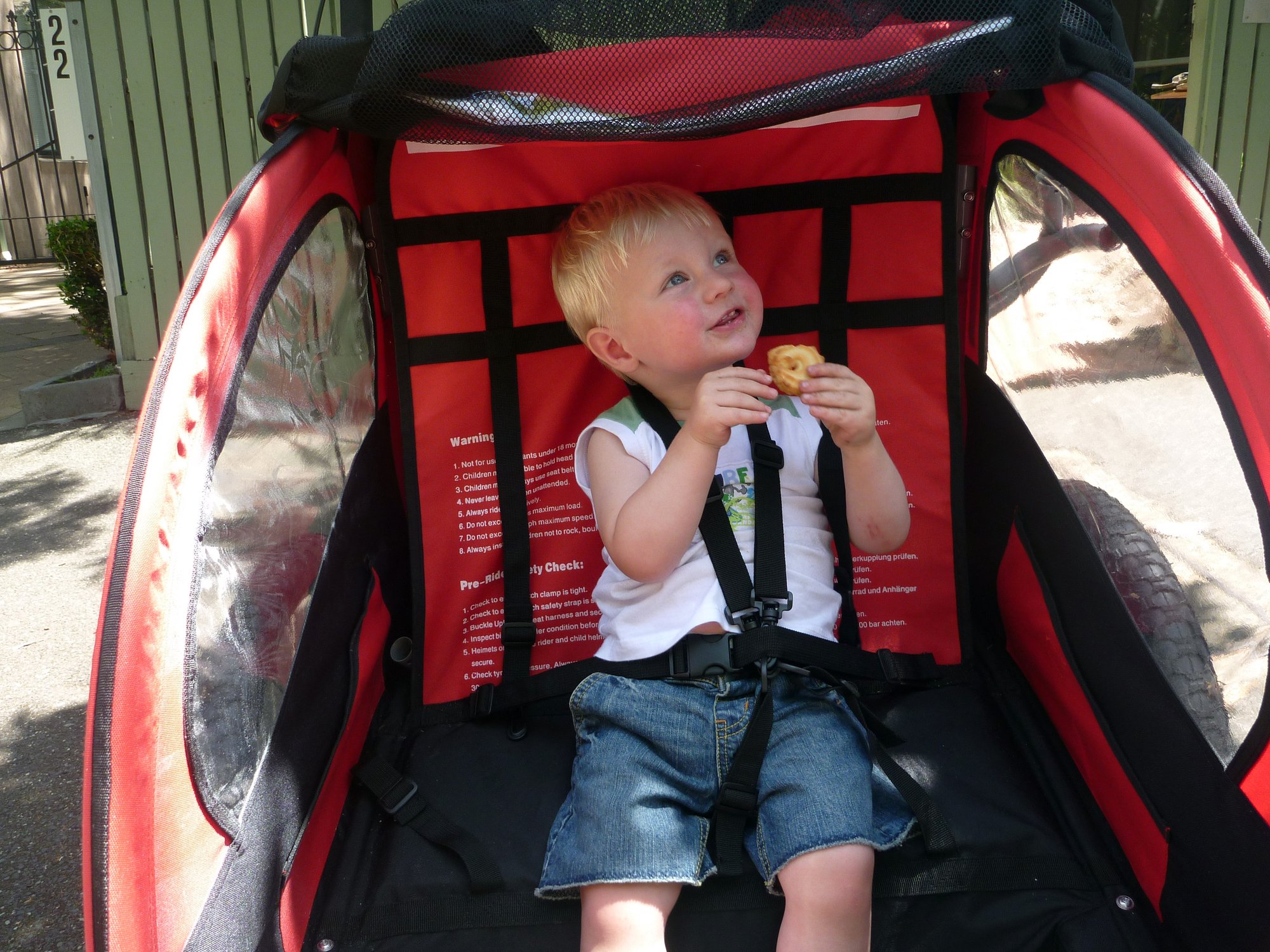
Single or double: the first decision
The vast majority of trailers on the market come in two versions: single (one child) and double (two children).
The single: lightweight and manoeuvrable
A single trailer generally weighs between 8 and 12 kg empty. It takes one child up to around 22 kg, sometimes 25 kg depending on the model. Width-wise, it measures roughly 75 to 80 cm — about the same as a standard Parisian cycle lane.
And that’s the first problem. Some of the capital’s protected lanes are 1.20 m wide. With a single trailer, you just about fit. With a double, you regularly spill over.
The double: versatility at the cost of bulk
A double trailer measures between 95 and 110 cm wide and can weigh up to 16 kg empty. With two children aboard, you’re pulling 40 to 50 kg with ease. You need a bike — and legs — up to the task.
The advantage: it grows with the family. You start with one baby, then add a second. And between school runs, it doubles up as a cargo trailer (Saturday morning shopping at the Marché d’Aligre, for instance).
Urban safety: the topic nobody talks about enough
In open countryside or on a greenway, a trailer is extremely safe — low, stable, protected by a rigid frame. In the city, the risks take a different shape.
Visibility: the first challenge
Modern trailers come fitted with safety flags, reflectors, and sometimes rear LED lights (Thule and Croozer offer this as standard on their premium ranges). This is essential in Paris, where taxis and motorised two-wheelers constantly brush past cycle lanes.
An orange safety flag — however unglamorous — is your best ally. Never remove it when riding in the city.
The jackknifing risk: the blind spot in most discussions
Less often mentioned, but very real: the risk of jackknifing between the trailer and the bike on tight turns. The hitch point is designed to absorb angles of 50° to 90° depending on the brand — but in a Parisian dead end or a crowded bike airlock, things can jam if you turn too quickly and sharply.
The rule: anticipate your turns, take them slowly — especially when loaded.
Parisian cycle lanes: sink or swim
Paris now has over 1,200 km of cycle lanes (source: Ville de Paris, 2024). But quality varies enormously. Some protected lanes — on the wide Haussmann boulevards — are broad and well-marked. Others, hastily painted onto narrow roads, measure just 80 cm wide. With a double trailer, you risk riding partly on the pavement or finding yourself in traffic.
Before committing to a trailer, ride your usual routes and mentally gauge the width of the lanes. It’s not romantic, but it’s essential.
The hitch: compatibility with your bike
This is the technical point most people overlook — and the one that causes the most disappointment.
Hitch systems: two main families
1. The rear axle hitch (quick release or thru-axle): this is the most common system used by Thule, Croozer and Burley. It replaces the rear wheel axle with a specific axle supplied with the trailer. Compatible with most road bikes, hybrid bikes, and standard mountain bikes.
2. The seatpost hitch: less common, used mainly on certain electric bikes whose rear hub isn’t compatible with the standard system. Less rigid, but more universal.
Problematic cases
- Hub-motor electric bikes: incompatible with the standard axle hitch. You’ll need a specific kit — check with your manufacturer.
- Carbon rear forks: some manufacturers advise against attaching a loaded trailer.
- City bikes with a coaster brake: generally compatible, but check the hub size.
Doing your homework before buying takes 30 minutes of reading — and saves you three hours of frustration at assembly time.
Recommended models for Paris
Thule Chariot Cross 1 and 2
The absolute benchmark. The Chariot Cross is the Rolls-Royce of trailers: robust, versatile (jogging, skiing, cycling), with 20-inch wheels that swallow Parisian cobblestones without too much jolting. The Cross 1 (around £850 / €950) is the single version; the Cross 2 (around £1,050 / €1,150) takes two children.
Its proprietary hitch (Thule Chariot Coupler) is among the sturdiest on the market. The trailer doesn’t wobble, even at 25 km/h. The waterproof hood and insect screen come as standard — much appreciated along the canal.
Croozer Kid for 1 and Kid for 2
The German alternative, slightly more affordable (around €750 to €900), and just as serious. The Croozer Easy-Fix system allows the hitch to be attached and detached in seconds — handy if you share the bike at home.
The Kid for 1 is particularly well-proportioned for Parisian cycle lanes. The Kid for 2 remains manageable in terms of width (103 cm) if you avoid the narrowest lanes.
Burley Bee
For those on a tighter budget: the Burley Bee (around €500) is a solid entry-level trailer, made in the USA, with an excellent reputation for reliability. Fewer features (no jogging kit, less sophisticated hood), but for regular urban rides around Paris, it more than does the job.
The convertible trailer: the €1,500 dream
The Thule Chariot Cross — like many premium ranges — can convert into a pushchair (with a wheels kit), a jogging buggy (with a pivoting front wheel), or even a Nordic ski trailer (ski kit available).
Is it worth the extra cost? That depends entirely on how you use it. If you cross-country ski in winter, jog during the week, and cycle at weekends, then yes — it pays for itself. But if you already have a pushchair and only use the bike from April to October, no — the extra kits will gather dust in a cupboard.
My honest advice: choose first and foremost a trailer that rides well. Everything else is marketing.
The cargo trailer without children: the overlooked option
Let’s talk about a use that many people overlook: the single trailer used as cargo.
Without the child seat, a Croozer or Thule trailer offers around 100 to 120 litres of volume. That’s enormous. For weekend shopping, transporting DIY materials, or moving a few belongings — it’s a credible alternative to a cargo bike.
And in Paris, where parking a cargo bike is a daily headache (I touched on this in our article on parking your cargo bike in Paris), the trailer has one major advantage: it detaches. You leave it in your stairwell, your bike stays outside on a rack. Simple.
A few home truths about trailers in Paris
I’m not going to sell you a dream. Trailers in Paris are wonderful on the big dedicated routes — along the Seine, the Coulée Verte, the Canal de l’Ourcq path. They’re trickier in the 11th arrondissement at rush hour or in the narrow lanes of the Marais.
Here’s what nobody always tells you: - Braking changes completely. With 30 kg behind you, your stopping distances increase significantly. You need to retrain your instincts. - Hills become obstacles. Paris has its reliefs. Montmartre, Belleville, the Butte-aux-Cailles: with a loaded trailer, expect to dismount or suffer. - Parking takes practice. Turning in a tight space with a trailer is a learnt skill. Give yourself a couple of weeks to find your bearings.
Conclusion: trailers, yes — but chosen wisely
A bike trailer is an extraordinary tool for Parisian cycling families — provided you don’t choose one at random. Take the time to gauge your usual lanes, check compatibility with your bike, and opt for a quality model rather than the cheapest entry-level option.
Between the Thule Chariot for the discerning, the Croozer for the pragmatic, and the Burley Bee for the sensible, there’s a trailer for everyone.
And if you’re not sure whether a trailer is the right choice for your daily commutes, take a look at our guide on the first cargo bike ride with children — it’ll give you a different perspective on family mobility in Paris.
— Marco B.